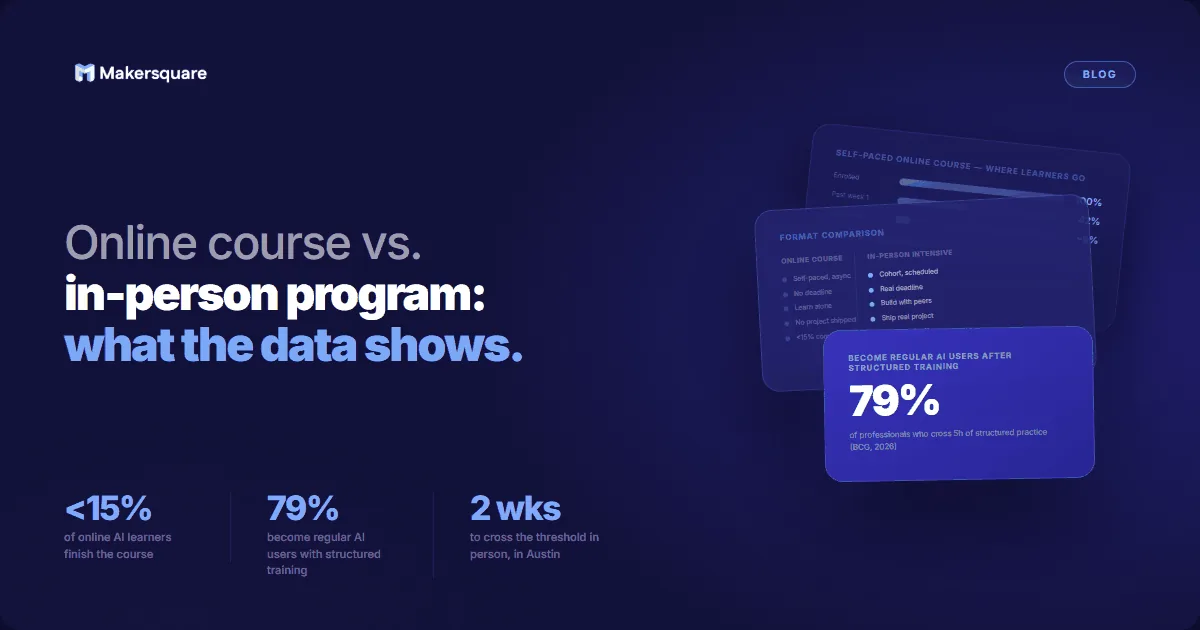
- Research consistently finds that fewer than 15% of people who start a self-paced online course finish it. For AI courses specifically, completion rates are often closer to 3 to 6 percent.
- BCG found that professionals who receive five or more hours of structured AI training are 79% more likely to become regular AI users, compared to those who haven't crossed that threshold.
- The gap between formats is not content. It's structure: accountability, compressed time, real projects, and learning with people working on the same problems.
- Online courses make sense for exploring a topic. In-person intensives make sense when the goal is to actually change how you work.
Online AI courses have a completion rate between 3 and 6 percent. That's not a criticism — it's a structural fact about what the format is optimized for. The question worth asking isn't whether online learning is good or bad. It's whether it can deliver what you're actually trying to accomplish. If the goal is exposure to AI concepts, a self-paced course is a reasonable starting point. If the goal is to change how you work, the completion data makes a strong case for a different format.
This isn't a knock on online learning as a category. It's a structural argument: what online courses are optimized for and what in-person intensives are optimized for are not the same thing. Understanding the difference makes it easier to choose the right one for the right goal.
At our Demo Night last week, one of the people who enrolled told us she'd already taken two online AI courses — good ones, well-reviewed, from credible platforms. She understood how AI worked. She just couldn't point to anything that had changed about how she actually did her job. That gap is the structural problem this post is about.
What online AI courses actually deliver
The online AI course market is enormous. Coursera, Udemy, DeepLearning.AI, fast.ai, and dozens of newer platforms offer courses ranging from free to a few hundred dollars, covering everything from prompt engineering to building AI agents. The content quality, in many cases, is genuinely good. Instructors with real depth, well-structured modules, practical exercises.
What online courses deliver well: structured exposure to a topic, the ability to learn at your own pace, breadth of coverage across AI tools and concepts, and low financial risk. For someone who wants to understand what large language models are, how vector databases work, or what the current tooling landscape looks like, an online course is a reasonable place to start.
What they do not deliver well is accountability, application, and the compression of learning that comes from having to ship something by a deadline in front of other people. That gap is where most learners stall.
The completion problem
The completion rate data on online courses is consistent enough to be treated as a structural fact of the format. Researchers at MIT and Harvard who studied massive open online courses found completion rates of 3 to 6 percent across tens of millions of enrollments. Paid platforms with more friction to enter perform better, but industry data still shows that fewer than 15% of learners who enroll in a self-paced online course complete it.
Why motivated people still quit
This isn't primarily a motivation problem. Most people who start an online AI course are motivated enough to enroll, pay, and begin. What erodes is the structure: no deadline, no one waiting for your work, no cost to stopping and restarting or never returning. The course stays in the library. Life continues. The skills don't compound because the practice doesn't happen consistently enough.
The implication for AI specifically is significant. Learning to work with AI tools is more like learning to cook than learning a fact. Understanding how a large language model works doesn't change how you work. Using one on your actual job tasks, failing, iterating, and building judgment about when it's useful and when it isn't: that's what changes how you work. Self-paced online formats make that harder to sustain.
What in-person AI training delivers differently
The difference an in-person intensive delivers is not curriculum. Most of the content covered in a well-designed in-person AI program is available somewhere online. The difference is what the structure forces you to do.
In-person programs impose external deadlines. You're not learning toward a vague goal of "getting better at AI." You have a project due at the end of the week, and the person next to you is watching you figure it out. That pressure changes how learning happens. The moments where you're stuck, confused, or tempted to move on without understanding become the moments where instructors intervene and peers fill the gap. That's the inflection point that most self-directed learners never reach, because there's no one in a YouTube video watching whether you understood section three before moving on to section four.
BCG's AI at Work research identified a threshold at five or more hours of structured training, after which 79% of professionals become consistent AI users. The key word is structured. Structured means someone has designed the sequence, the accountability, the feedback loop, and the outcome you're working toward. Self-paced courses can be well-structured in terms of content. What they can't replicate is a room of people held to the same timeline with the same goal.
For the organizational context, the post on how to get ROI from AI at work covers this from the employer side: the BCG data shows that companies where employees have structured AI training achieve 67% higher ROI than peers without it. That ROI gap comes from skill transfer, not content coverage.
The cohort effect: why the room matters
There's a second structural advantage to in-person learning that rarely gets mentioned in comparisons: who you're in the room with.
A cohort of professionals working on AI in parallel is not just a social benefit. It's a learning mechanism. When someone in the room figures out a better way to prompt Claude for a financial model, or solves a Cursor problem you've been stuck on for an hour, that knowledge transfers immediately. When you see what someone with a completely different job function builds in two weeks, it expands what you think is possible with the same tools you have access to.
It also changes how you leave. A professional who completes an in-person AI intensive has a network of people who went through the same thing, can debug the same tools, and are experimenting with AI in their own organizations. That network is a continued learning resource in a way that a discussion forum under a Coursera module is not.
For more on what the gap between knowing about AI and being able to use it actually costs, the second post in this series covers what another year without AI skills actually costs in concrete career terms.
Which format is right for you
Online courses make sense if you want to explore whether AI is relevant to your work before committing time or money, if you're looking to understand a specific tool or concept and already have the self-direction to follow through, or if the cost of an in-person program isn't feasible right now.
An in-person intensive makes sense if you've already tried online courses and stalled, if the goal is to build something real and change how your team uses AI, if you're a founder or operator who needs to move quickly and can't afford a six-month learning curve, or if you know that left to your own schedule, this will stay on the list.
The most common version of this we see: someone with a half-completed Coursera certificate and nothing that changed about how they actually work. That's a reasonable starting point. It's also a pretty clear signal.
You already know the online version didn't stick. MakerSquare is two weeks, in person, in Austin. You leave with something built around your actual work — not a course completion certificate, but a tool that's already running. The curriculum shows exactly what that looks like.