- The customer service AI approaches that are working are AI-assisted human agents and narrowly scoped chatbots for high-volume routine queries — not full automation of complex support.
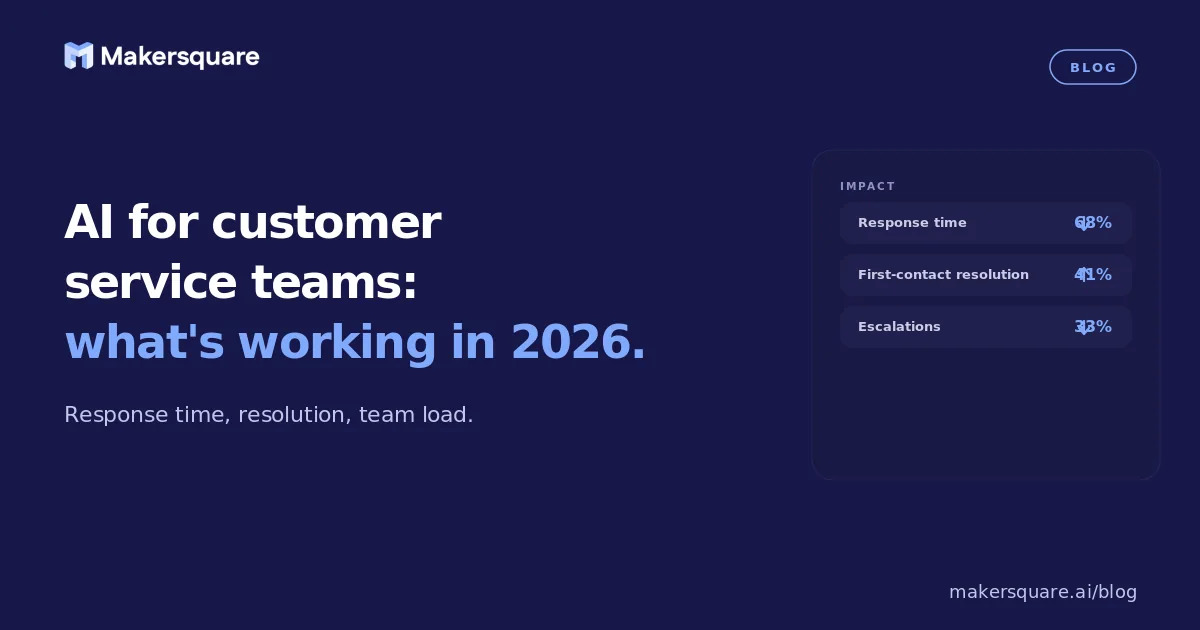
- AI agent assist tools (which suggest responses to human agents in real time) are producing the most consistent CSAT improvements — typically 15–25% reduction in average handle time without reducing customer satisfaction.
- The most common AI customer service mistake: deploying a chatbot that can't escalate to a human. Customers who hit a dead end become actively hostile rather than just unsatisfied.
- Salesforce's 2025 State of Service report found that high-performing service organizations are 2.8x more likely to have deployed AI agent assist tools than low-performing ones.
Customer service is the function where the gap between "AI hype" and "AI reality" is most visible. On one side, companies have deployed chatbots that trap customers in loops and produce angry social media posts. On the other, a smaller group of companies has used AI to reduce handle time, improve first-contact resolution, and free up agents for the conversations that actually require a human. The difference is not the technology — it's how it's deployed.
The short answer: AI for customer service works well for high-volume routine queries handled by well-scoped chatbots, and for agent assistance tools that support (not replace) human agents on complex cases. It works poorly when it tries to fully automate interactions that require empathy, judgment, or escalation authority.
What's actually working: AI agent assist
The highest-performing AI application in customer service right now is not chatbots — it's agent assist. These are tools that sit alongside human support agents during live interactions and provide real-time support: suggested response drafts, links to relevant knowledge base articles, automatic sentiment detection, and post-interaction note drafting.
The impact is consistent across studies. Salesforce's 2025 State of Service report found that companies using AI agent assist tools reported 20–30% reduction in average handle time and 18% improvement in first-contact resolution rates, without a corresponding drop in CSAT.1 The mechanism is straightforward: agents spend less time searching for information and drafting responses, and more time actually talking to customers.
This is the AI deployment model that works at scale — not replacing agents, but making each agent more effective. The best agent assist tools learn from your specific knowledge base and previous successful interactions, so they improve over time.
Chatbots: the narrower the better
Chatbots work in customer service when they're narrow, well-trained, and have a clear path to human escalation. The chatbots that fail are the ones tasked with handling "all customer service" — an impossibly broad brief that inevitably produces wrong answers, frustrated customers, and a worse outcome than just answering the phone.
The chatbots that work handle a defined set of high-volume queries: order status, refund requests, password resets, appointment scheduling, FAQ answers. These are interactions that are high in volume, low in complexity, and where speed matters more than nuance. A well-trained chatbot that handles 60% of your ticket volume for these query types frees your human team for the 40% that actually needs them.
The critical design decision: every chatbot interaction needs a low-friction path to a human agent. Not buried in a menu. Not available only after three failed attempts. Immediately accessible on request. Customers who can easily reach a human when they need one are far more tolerant of chatbot limitations.
What's not working: fully automated complex support
The pattern that's generating the most negative customer experience data is companies using AI to fully replace human agents in high-complexity, high-emotion interactions. Billing disputes, service failures, situations where something has gone meaningfully wrong — these require empathy, authority to make decisions, and judgment about what the right outcome actually is. AI doesn't have any of these.
A 2025 Gartner study found that customer satisfaction scores in interactions that were fully AI-handled dropped 12 points compared to human-handled interactions for the same query types, specifically in cases rated medium or high complexity by the customer.2 The lesson: scope AI to the interactions it can handle well, and preserve human capacity for the ones it can't.
What this means for customer service teams
The customer service leaders who are getting this right have made a deliberate decision about what AI should and shouldn't do. They've identified their highest-volume, lowest-complexity query types, built narrow chatbots for those, deployed agent assist for everything else, and kept human agents available for escalation at every touchpoint. That's a more deliberate and conservative deployment than most AI vendors will recommend — and it's producing better outcomes.
MakerSquare is a 2-week in-person AI builder program in Austin, TX — built for operators, founders, and professionals who want to build real AI tools, not just use them. Customer service leaders and operations managers attend to build specific AI workflows for their function — including support chatbots and agent assist configurations. The curriculum covers what that looks like in practice.
The best AI in customer service is invisible to the customer. They get a faster answer, their agent seems more prepared, and the whole interaction takes less time. That's what good deployment looks like — and it's achievable right now with the tools that exist.
Join the AI Builder Brief for weekly practical AI insights — including customer service AI, workflow automation, and what's actually working in 2026.