Teaching and coaching are time-intensive in ways most people outside those fields don't fully appreciate. The visible hour — the class session, the coaching call — is often a fraction of the total time. The preparation, the curriculum development, the follow-up, the administrative documentation: that's where time actually goes. AI for educators and coaches is most valuable precisely there — in the preparation and administrative layers, not the direct relationship itself.
This guide covers what's working in 2026 for educators (K-12, higher ed, corporate trainers, course creators) and coaches (executive, life, business, professional). The applications are distinct enough to treat separately, but the underlying principle is the same: AI handles the production work; the human handles the relationship.
- AI for educators delivers the most value in curriculum development, assessment creation, and student feedback at scale.
- AI for coaches is highest-leverage for session prep, progress documentation, and scaling content into group or digital programs.
- AI session transcription and summary (Fathom, Otter.ai) is the fastest win for coaches — immediate, low-effort, high-value.
- The live instructional or coaching relationship cannot and should not be automated. That's the premium.
- Educators who use AI most effectively treat it as a curriculum thought partner, not a content generator to publish without review.
For educators: the biggest time sink AI can address
Ask most educators where their time goes, and the answers are consistent: lesson planning, adapting materials for different learning levels, creating assessments, providing written feedback on student work, and administrative documentation. None of these require the expertise of a skilled educator — they require time. AI addresses time problems effectively.
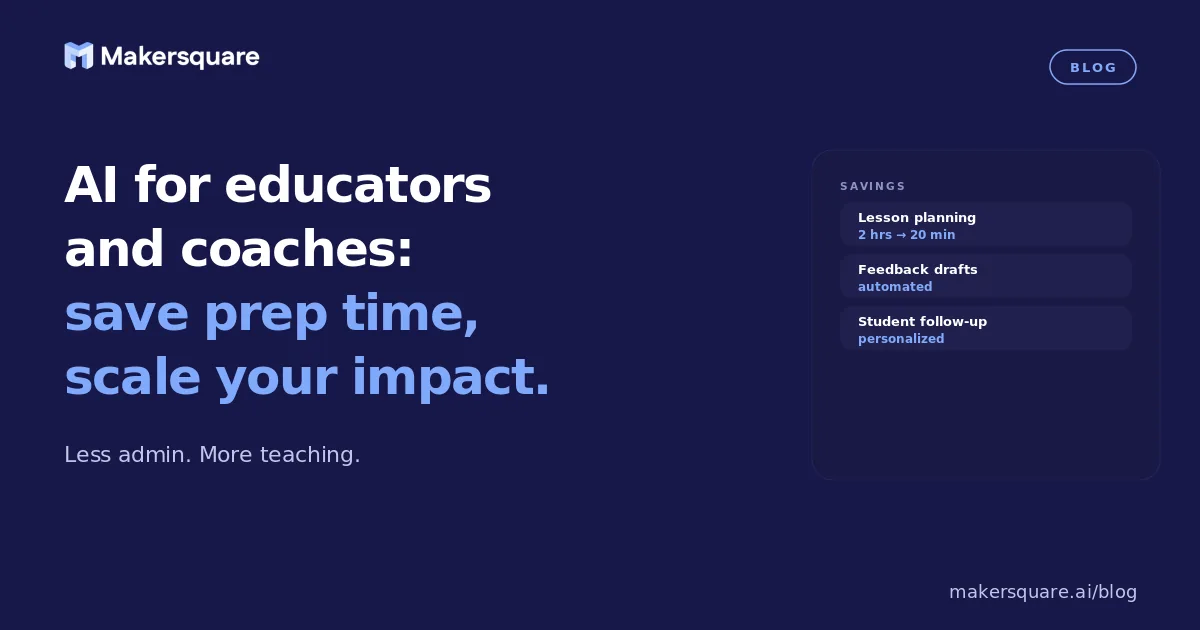
Lesson plan and curriculum development. AI is a strong thought partner for curriculum structure. It can generate a unit plan outline from a learning objective, suggest activities for different learning styles, propose discussion questions, and identify common misconceptions for a given topic. The output is a starting point, not a final product — but it eliminates the blank-page problem that consumes hours of planning time.
A Stanford HAI study on AI in education found that teachers using AI for curriculum planning reduced planning time by 30–40% while reporting that the quality of their lesson plans improved — because AI generated more options than they would have produced alone, giving them more to choose from and build on.
Assessment and quiz creation. Creating high-quality assessments — questions at the right difficulty level, well-designed rubrics, varied question formats — is time-intensive. AI can generate first-draft assessments from learning objectives in minutes. The educator reviews for accuracy, adjusts difficulty, and edits for their context. What used to take two hours takes 30 minutes.
Student feedback at scale. Written feedback on student work is one of the highest-value activities for learning outcomes and one of the most time-consuming activities for educators. AI doesn't replace this feedback — but it can help structure and accelerate it. Provide AI with a rubric, a student submission, and a few examples of strong feedback, and it generates structured feedback that the educator edits and personalizes. This is particularly valuable in higher-volume settings (corporate trainers, online course creators) where individual feedback at scale is otherwise impractical.
For educators: what AI can't do (and shouldn't try)
The classroom relationship — reading the room, responding to confusion in real time, building the psychological safety that makes learning possible — is not automatable. Neither is the curriculum judgment that comes from knowing your specific students: their backgrounds, their misconceptions, their learning history with you. AI doesn't know any of that.
The risk educators face is using AI to generate curriculum content at scale without adequate review. AI knows general principles of whatever subject you teach. It doesn't know your specific students, your school culture, your teaching philosophy, or the specific gaps in understanding that a skilled teacher perceives in a room. AI-generated curriculum that's published without educator judgment produces generic content that underserves students.
Use AI to reduce the production time of things you would have created anyway. Don't use it to skip the thinking that makes your teaching distinctive.
For coaches: the highest-leverage starting point
If you coach and haven't implemented AI session transcription, start there. It's the fastest ROI with the least effort.
Tools like Fathom (for Zoom calls) and Otter.ai automatically transcribe coaching sessions and generate AI summaries that capture key themes, client commitments, and coaching observations. Instead of spending 20–30 minutes after every session writing notes, the AI draft is ready immediately and takes 5 minutes to review and adjust.
Beyond time savings, the quality of session documentation improves. AI captures things that coaches miss because they were actively listening — a specific phrasing the client used to describe their challenge, a commitment made in passing, a pattern that connects to previous sessions. Better documentation means better follow-up, which means better outcomes for clients.
For coaches: scaling your methodology without scaling your hours
The fundamental constraint for coaches is time: there are only so many 1:1 hours in a week. AI helps coaches escape this constraint by making their methodology more scalable:
Group programs and digital courses. AI accelerates the content development work that coaches typically spend months on: writing curriculum, developing exercises, creating worksheets, producing case studies and worked examples. AI-assisted content development doesn't make content creation effortless, but it reduces the production time enough that building a group program becomes feasible alongside an active 1:1 practice.
Between-session resources. AI can help coaches develop personalized between-session materials — reflection prompts, practice exercises, reading recommendations — based on what emerged in a session. Coaches who previously relied on memory or hurried post-session notes can now generate tailored resources quickly.
Progress tracking and reporting. For coaches working with corporate clients or accountability-focused programs, AI can help synthesize progress notes into structured reports. Coaching progress is often qualitative and hard to document — AI helps structure the documentation without losing the nuance.
Course creators: the AI use case most online educators underestimate
For educators who sell digital courses or programs, content repurposing is the most underutilized AI application. A single live training session — 60–90 minutes of recorded content — can become:
- A full transcript (AI, immediate)
- A written summary with key frameworks (AI, 10 minutes)
- A set of reflection questions (AI, 5 minutes)
- LinkedIn posts based on the key insights (AI, 15 minutes)
- An email for program participants summarizing what was covered (AI, 10 minutes)
- An FAQ document based on questions asked (AI, 10 minutes)
Without AI, most of this content gets created once, used once, and discarded. The production cost to repurpose it is too high. With AI, the production cost drops to an hour of editing work for content that would have taken a day to create from scratch.
HubSpot's Content Marketing research found that content repurposing is the highest-ROI content activity for educators and knowledge creators — and AI has made it significantly more accessible. The bottleneck is now curation and editing, not production.
The AI tools worth knowing about
For educators and coaches, these tools cover most of the use cases above:
- Claude or ChatGPT: Curriculum development, lesson planning, assessment creation, session prep, between-session resources. The general-purpose AI tools handle most text-based production tasks well.
- Fathom: Session transcription and AI summary for Zoom calls. Free for individuals. The summary quality is genuinely useful, not just a transcript dump.
- Otter.ai: Session transcription with speaker identification and AI summary. Works across platforms, not just Zoom.
- Notion AI: Building knowledge bases, client-facing resources, and collaborative curriculum. AI features integrated directly into where the content lives.
- Descript: For course creators recording video content — AI editing, transcript-based editing, and content repurposing tools built in.
- Loom: Async video with AI-generated summaries. Strong for coaches sending video follow-ups between sessions.
MakerSquare is a 2-week in-person AI builder program in Austin, TX — built for operators, founders, and professionals who want to build real AI tools, not just use them. Coaches and educators who attend often build custom tools for their specific workflow: client onboarding automations, knowledge base assistants pre-loaded with their methodology, or progress-tracking systems that reduce administrative overhead significantly.
MakerSquare is an in-person AI builder program in Austin, TX. No coding background required. Real products. Real time savings.