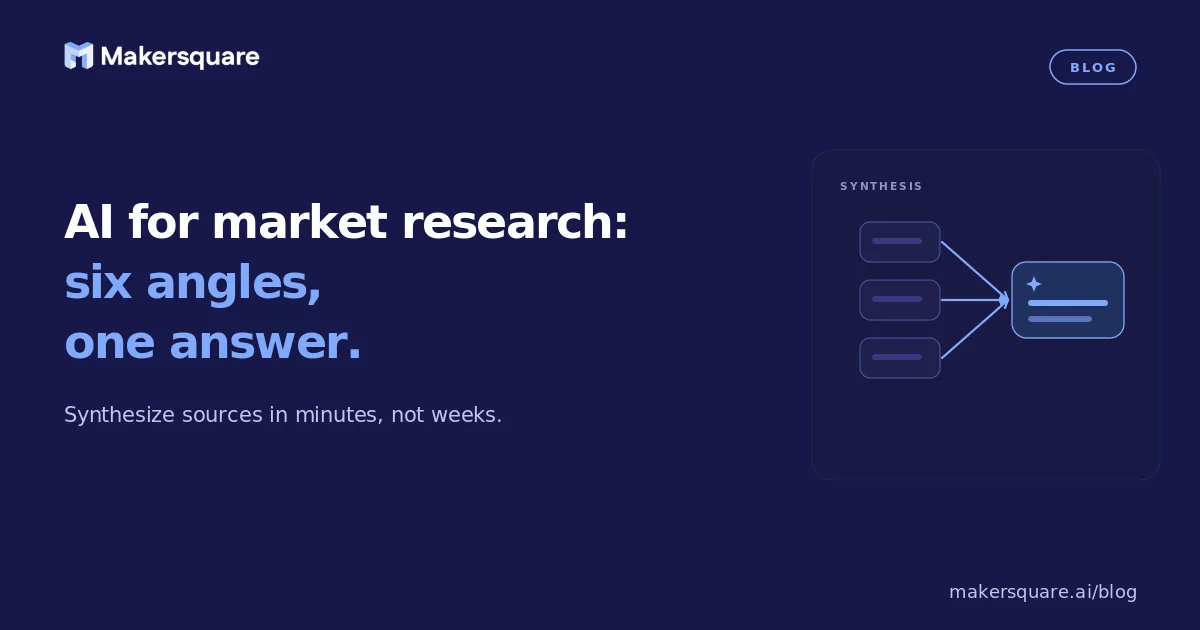
- AI's real edge in research isn't one better search - it's running many angles at once and synthesizing them into a single answer in minutes.
- 38% of knowledge workers now use generative AI daily, up from 11% in 2024 - research and synthesis is one of the most common uses.
- The trap is treating AI research as final. It's excellent at gathering and structuring; a human still verifies the sources and makes the call.
- The workflow that holds up: AI runs the breadth (multiple angles, fast synthesis), you supply the judgment (what's credible, what it means, what to do).
Market research has always faced the same tension: doing it properly takes weeks, but decisions can't wait weeks. AI collapses that tradeoff - but only if you use it for what it's actually good at. The direct answer: AI's real leverage in market research is running many angles on a question simultaneously and synthesizing them into one coherent answer in minutes, while you stay the judgment layer that verifies sources and decides what it means.
Why 'six angles, one answer' beats one better search
Most people use AI for research like a faster Google - one question, one answer. That undersells it badly. The real unlock is breadth: instead of asking one broad question, you have AI investigate the same problem from several specific angles at once - the market size, the main competitors, what customers complain about, what's changing, what the skeptics say - and then merge everything into a single synthesized view. A person can't hold six research threads in parallel; AI can, and then it compiles them. That's a genuinely different capability, not just a speed-up, and it's why research is one of the most common daily uses of AI - now that 38% of knowledge workers use generative AI daily, up from 11% in 2024.
What AI does well - and where it stops
AI is strong at: gathering information across many sources fast, structuring it into a comparable format, surfacing themes and contradictions you'd miss reading serially, and drafting the research summary. This is the tedious, time-heavy 80% of research.
AI is not reliable for: judging which sources are actually credible, catching when a confident-sounding claim is wrong or outdated, and making the decision the research is meant to inform. It will present a plausible synthesis whether or not the underlying sources are solid. That verification-and-judgment layer is exactly where your expertise now adds the most value.
The workflow that produces research you can trust
The reliable pattern is a division of labor. Let AI run the breadth - the multiple angles, the fast gathering, the first-pass synthesis. Then you do three things a person has to: spot-check the key claims against real sources, apply judgment about what's credible and what it means for your specific situation, and make the call. Research that skips the human verification step is fast and risky; research that uses AI for breadth and a human for judgment is fast and sound. The second is a genuine competitive advantage - the analysis a competitor spends two weeks on, done in an afternoon and still trustworthy.
What this means for how you make decisions
Getting real value here is a workflow skill, not a technical one - knowing how to direct the breadth and where to apply your own judgment. It's the same principle MakerSquare is built on, and our builders take it further: our use cases include agents that run multiple research angles and compile them automatically, so the whole 'six angles, one answer' loop becomes a tool you run on demand.
The best market research isn't the fastest or the most thorough. It's the fastest one you can still stand behind.
MakerSquare is a 2-week in-person AI builder program in Austin, TX where operators build real tools - like an agent that runs multiple research angles and compiles them - around the decisions they actually make. See what two weeks of hands-on building looks like.