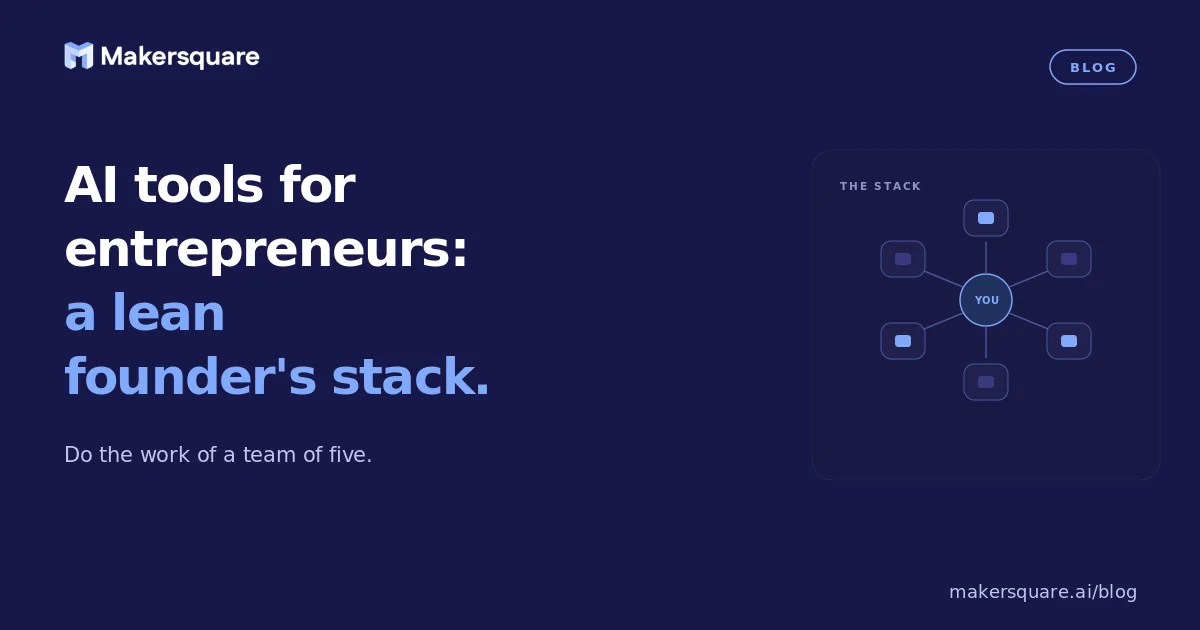
- AI lets a solo founder or tiny team credibly cover functions that used to require a small staff - marketing, sales, research, ops, and support.
- The winning stack is small: a general assistant plus a few function-specific tools, used deeply - not a sprawling collection of apps.
- The leverage isn't the tools - it's applying them to a problem you understand. The founders getting the most from AI aren't the most technical.
- Use AI to buy time and reach, not to skip the fundamentals: a real problem, a real customer, and something that solves it.
Being a founder has always meant wearing every hat at once. AI is the first thing that genuinely makes that survivable - and even an advantage. The direct answer: AI tools let an entrepreneur credibly do the work of a small team across marketing, sales, research, operations, and support - and the winning approach is a lean stack used deeply, not a sprawling one used shallowly, aimed at problems you actually understand.
The real promise: a team of five, solo
What used to require hiring - a marketer, a researcher, a support rep, an analyst - a founder can now credibly cover with AI as the multiplier. That's not a claim that AI replaces a great team; it's that it lets a founder go much further before needing one, staying lean and moving fast while figuring out what actually works. For a bootstrapped or early-stage founder, that extended runway of capability is the difference between reaching traction and running out of road.
The lean founder's stack, by function
The core: a general assistant. Claude, ChatGPT, or Gemini - your default for writing, research, analysis, planning, and drafting almost anything. This one tool covers more founder tasks than any other and is where most of the value is.
Marketing and content. AI for drafting posts, emails, and copy, plus the built-in AI in your design and social tools.
Sales. AI for prospect research, personalized outreach drafts, and follow-up tracking.
Operations and support. AI for customer FAQs, meeting notes, scheduling, and turning data into plain-English summaries.
The key discipline: this is a short list, used hard. The temptation is to collect a dozen shiny AI apps; the reality is that a couple of tools applied relentlessly to your highest-frequency work beats a bloated stack every time.
The part the tool lists leave out
Here's what matters more than any tool recommendation. The leverage isn't the AI - it's applying it to a problem you understand better than most. The founders getting the most from AI aren't the most technical; they're the ones who know their business and customer well enough to point the tools at the right things. AI can draft your marketing, but it can't tell you what your customers actually want. It can analyze your options, but it can't make the founder's calls. Use AI to buy time and reach - not to skip the fundamentals of a real problem, a real customer, and something that solves it.
What this means for founders
The founders who win with AI treat it as a force multiplier on their own judgment, not a substitute for it - and building it into how they actually operate is a practical skill, not a technical one. That's the entire premise of MakerSquare. Our use cases show what founders build when they go from using AI tools to building real ones around their business.
AI can do the work of a team of five. Deciding what that team should be working on is still your job - and it's the one that matters.
MakerSquare is a 2-week in-person AI builder program in Austin, TX for founders who want AI as a force multiplier - and to go from using tools to building real ones around their business. See what two weeks of hands-on building looks like.