- AI tools for lawyers have moved from experimental to mainstream in 2026 — adoption at large firms is above 70%, and the tools have gotten dramatically more reliable since 2023.
- The highest-leverage applications are contract review, legal research synthesis, and first-draft document production — tasks where AI compresses hours into minutes.
- The Hallucination risk hasn't disappeared, but legal-specific AI tools have reduced it significantly compared to general-purpose models used without guardrails.
- The biggest shift in 2026 is that AI fluency is becoming a differentiation factor between firms — not just a productivity tool, but a client-facing competitive advantage.
Two years ago, the conversation about AI tools for lawyers was mostly about risk: hallucinated cases, ethics concerns, bar association caution. Today, that conversation has shifted. The risks are better understood, the tools have improved substantially, and the question has changed from "should lawyers use AI?" to "which tools are worth using, and how?"
The direct answer: AI tools for lawyers create the most value in document-heavy, pattern-recognition work — contract review, research synthesis, first drafts of standard documents. The tools have gotten meaningfully better in 2026, and the lawyers not using them are increasingly at a competitive disadvantage, not a safety advantage.
What's actually changed in the last 18 months
Three things have changed that matter more than most of the AI-in-law coverage acknowledges.
Legal-specific models have significantly reduced hallucination risk. Tools like Harvey AI, Thomson Reuters CoCounsel, and Clio Duo are built on top of general models but fine-tuned on legal corpora and built with citation verification layers. They're still not infallible — no AI tool is — but the hallucination problem that produced cited-fake-cases headlines in 2023 is substantially reduced when you're using purpose-built legal tools rather than general ChatGPT.
Context windows got large enough to change the work. Models that can process 100,000+ tokens mean you can now upload an entire contract or a full set of deposition transcripts and get a meaningful analysis across the whole document at once. This wasn't possible two years ago. It changes what document review looks like.
Bar associations and courts have clarified their positions. Most state bar associations have now issued guidance permitting AI use in legal practice with appropriate attorney oversight and competence requirements. Courts have issued standing orders for AI disclosure. The regulatory ambiguity that made cautious lawyers hesitant has mostly resolved — the answer is generally "yes, with supervision."
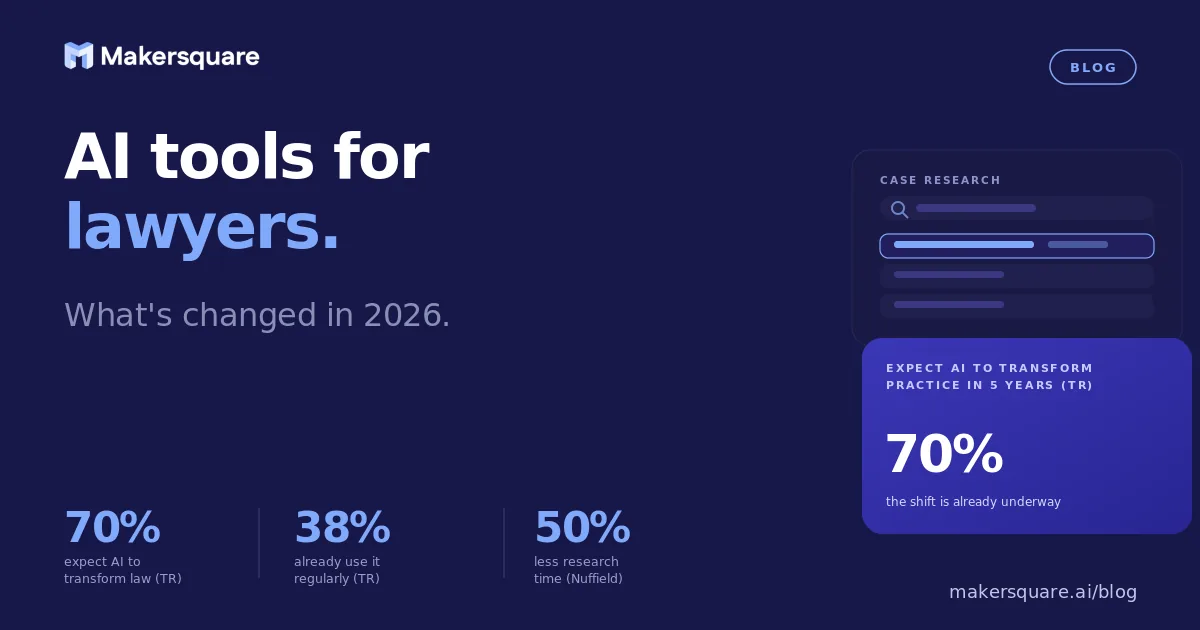
A 2025 Thomson Reuters Future of Professionals Report found that 70% of legal professionals expect AI to transform the practice within five years, and 38% are already using it regularly in their work. Those numbers have been climbing steadily since 2023.
Where the real leverage is in 2026
The use cases where AI creates the most leverage for lawyers haven't changed much — but the tools doing them have gotten better.
Contract review and redlining. This is where the ROI is most clear. Tools like Spellbook, Ironclad AI, and Harvey can review a contract against a playbook, flag non-standard terms, and generate a redline in a fraction of the time manual review takes. For transactional practices doing volume contract work, this is the single highest-leverage application.
Legal research synthesis. AI won't replace Westlaw or Lexis for primary source research — but it's transforming what you do with the research once you have it. Feeding a body of case law to Claude or a legal AI tool and asking for a synthesis of how courts have treated a specific issue, with the tension points identified, compresses what used to be a half-day task.
First-draft production. Demand letters, motions, client memos, NDA agreements, engagement letters. AI handles the structural scaffold and standard language. The lawyer brings the judgment about what the document needs to accomplish and edits accordingly. For solo practitioners and small firms, this is where AI most directly affects capacity and revenue.
A Nuffield Foundation study found that AI-assisted legal research cut research time by approximately 50% on comparable tasks, with quality maintained when attorneys reviewed and verified output. The time savings compound across a practice.
The risk that actually matters — and it's not hallucination
The risk that gets the most press is hallucination — AI generating a plausible but fictional case citation. That risk is real, and it's why you verify output before it goes anywhere near a client or a court. But it's a manageable risk, and it's decreasing as legal-specific tools improve.
The risk that gets less coverage is competence risk in the other direction: the lawyer who becomes dependent on AI for work they don't understand well enough to supervise. If you can't tell when an AI-generated contract clause is wrong because you don't know the underlying law well enough, the AI hasn't helped you — it's created liability.
The professional responsibility framework is clear: AI is a tool, and the supervising attorney is responsible for the work product. That cuts both ways. It means you can use AI. It also means you need to understand the output well enough to catch errors. For experienced attorneys who know their domain, AI is a powerful accelerant. For practitioners who use AI to work outside their competence area, the risk is different and real.
What this means for lawyers building AI skills
The question for most lawyers isn't whether to use AI tools — it's which ones, and how to build the judgment to use them well. The lawyers who are ahead right now figured out which tasks in their practice benefit most from AI, found the right tool for each, and built those workflows into how they work every week.
MakerSquare is a 2-week in-person AI builder program in Austin, TX — built for operators, founders, and professionals who want to build real AI tools, not just use them. Legal professionals who come through the program leave with working AI workflows built around their specific practice — not a generic overview. See the full curriculum to understand what that looks like in practice.
The lawyers who understand AI well enough to supervise it, customize it for their practice, and use it as a genuine competitive advantage — they're pulling ahead. That gap is widening, not narrowing.
Want to build a working AI workflow for your legal practice? Download the MakerSquare curriculum — it covers the tools, prompting frameworks, and hands-on projects that turn AI fluency into a real practice advantage.