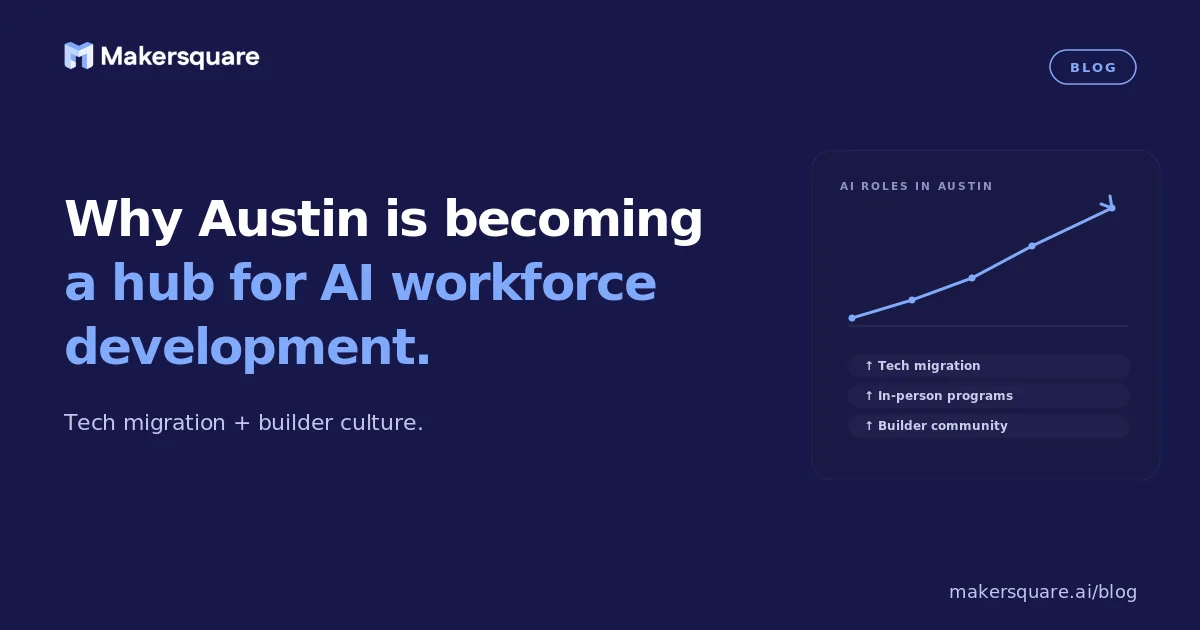
- Austin's emergence as an AI workforce development hub is driven by a specific combination: high AI skill demand, a dense tech employer base, and a professional population that moves fast and builds things.
- AI-related job postings in Austin grew 120% from 2023 to 2025 — but the supply of practical, applied AI training hasn't kept pace with that demand.
- The in-person AI training programs taking root in Austin serve a fundamentally different audience than online courses: mid-career professionals who want to apply AI to their existing work, not change careers.
- The non-obvious reason Austin is well-positioned: its culture of "build first" attracts professionals who are self-selected to actually do the work, not just consume content about it.
Something specific is happening in Austin's professional education landscape. The city that became a tech hub through company migrations and startup growth is now seeing a second wave: AI workforce development programs building out infrastructure for the working professionals those companies employ.
Austin is becoming a hub for in-person AI training not because of any single initiative, but because of the convergence of three things: a dense concentration of tech employers creating AI skill demand, a self-selecting professional population that wants to build rather than just learn, and a geography that makes in-person community formation natural. Here's what's behind it and what it means for professionals in the city.
The demand side: Austin's AI skill gap
Austin's tech industry concentration accelerated dramatically from 2020–2024. Tesla's Gigafactory and AI division, Apple's campus expansion, Oracle's headquarters relocation, and a consistent pipeline of high-growth startups created one of the densest non-SF tech employer ecosystems in the country.
With that employer concentration came AI adoption pressure. Every company of scale is actively trying to integrate AI into operations, marketing, sales, and product — and most are discovering that their existing workforce, however talented, doesn't have the practical AI skills to execute that integration effectively. According to LinkedIn's 2025 Jobs on the Rise report, AI-related job postings in Austin grew 120% from 2023 to 2025 — among the highest growth rates of any metro area in the country.
The supply of trained AI talent hasn't kept pace. UT Austin produces strong computer science and data science graduates, but they're not the primary workforce for the majority of AI use cases inside companies. The actual need is for operations managers, marketers, sales professionals, consultants, and business leaders who can use AI tools to change how they work. That's not a university pipeline problem — it's a continuing education problem.
The supply side: what Austin's builder culture produces
Cities have cultures, and Austin's is unusually oriented toward building, founding, and moving fast. SXSW, a density of founders, and a steady in-migration of people who deliberately chose Austin over more established tech hubs — these patterns attract people who are self-selected to try things, not just observe them.
This matters for AI training because the biggest barrier to AI skill development is inertia, not knowledge. Most professionals have access to AI tools. Most have read about what's possible. The gap is between reading about it and building something with it. In a culture where "I built this" is a point of pride and "I'm still evaluating" is vaguely embarrassing, that gap closes faster.
A Brookings Institution analysis of Austin's economic development found that the city's growth is driven significantly by its ability to attract and retain early-career and mid-career professionals who are drawn specifically by professional opportunity and a culture of entrepreneurship — not just by lower cost of living. That self-selection produces a professional population that's more likely to invest in skill development and more likely to actually apply what they learn.
Why in-person training matters in this context
The case for in-person AI training in Austin is not just about the content — it's about the community. When 15 professionals from Austin companies go through a 2-week AI builder program together, they don't just leave with skills. They leave with a peer network of people who are building AI tools in their specific professional context.
That network has compounding value. When you're debugging a workflow, having a colleague who went through the same program and built something similar is more useful than any tutorial. When you're trying to convince your manager that an AI investment is worth it, having peers who made the same investment and can share results is powerful. In-person training creates this in a way that online courses structurally can't.
According to Emsi Burning Glass's 2025 Austin Workforce Report, demand for AI-adjacent skills in Austin's non-technical workforce — operations, marketing, sales, and management — grew faster in 2025 than demand for traditional software engineering skills. The workforce development gap is in the professional population, not the engineering pipeline.
What this means for Austin professionals
If you're a professional in Austin and you're watching AI adoption accelerate in your industry, the window for building a meaningful skill advantage is narrowing. The people who build real AI skills in the next 12–18 months will have a durable edge over those who wait for the tools to get simpler or the training to get cheaper.
MakerSquare is a 2-week in-person AI builder program in Austin, TX — built for operators, founders, and professionals who want to build real AI tools, not just use them. It's built on the conviction that Austin's professional community is uniquely positioned to lead AI adoption in the mid-market — and that what's missing isn't access to tools, but access to the right kind of training. See the full curriculum at makersquare.ai/curriculum.
The cities that produce the most AI-capable workforces in the next five years won't be the ones with the most AI companies — they'll be the ones with the best infrastructure for turning working professionals into practical AI builders. Austin is building that infrastructure now.
Ready to actually build this? MakerSquare runs in-person AI training and classes in Austin — a 2-week intensive where non-technical professionals build real, deployed AI tools.
MakerSquare runs cohorts in Austin year-round for the professionals building the next wave of AI-enabled businesses. Join the AI Builder Brief to stay current on what's being built.