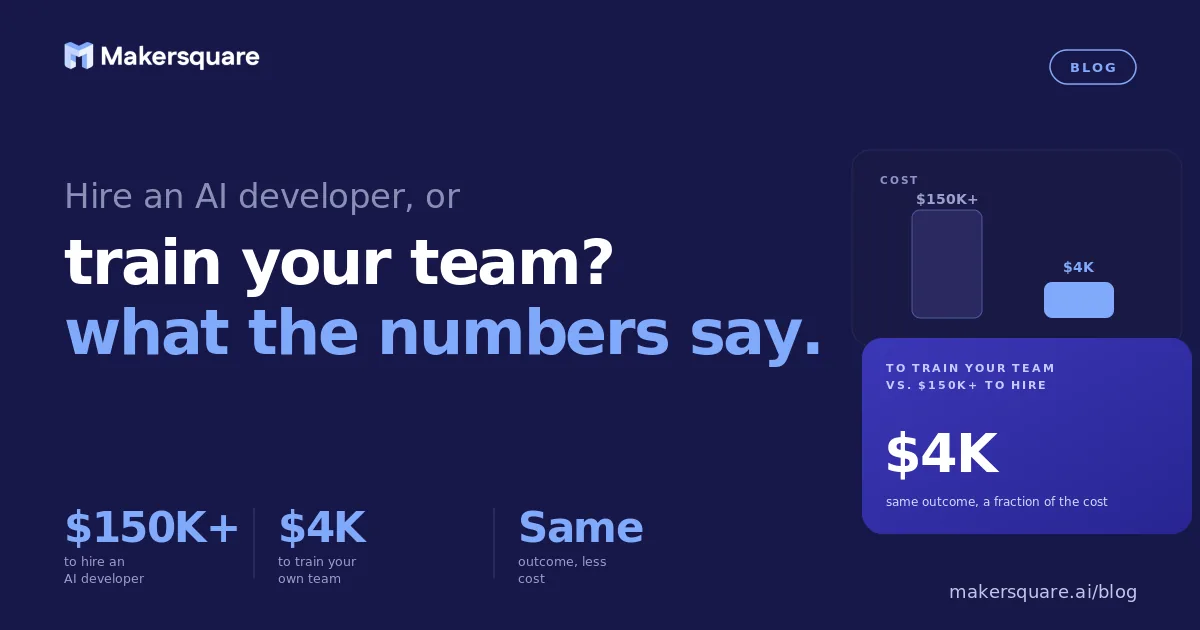
- A mid-level AI developer in 2026 costs $180,000–$240,000 in salary alone, plus benefits, recruiting fees, and a 3–6 month ramp time before they're productive.
- Training 2–3 existing team members to handle AI projects costs a fraction of that — and preserves institutional knowledge that a new hire doesn't have.
- The speed advantage matters: training takes weeks. Hiring takes months. In a fast-moving landscape, the timeline difference is itself a competitive factor.
- The hybrid approach often wins: train 2–3 internal people as AI leads, then hire one senior AI developer to support what they build.
For most organizations, training your existing team costs a fraction of hiring a dedicated AI developer, takes weeks instead of months, and builds capability your people keep — not capability that walks out the door if a hire leaves. Most organizations approaching the AI talent question are working off instinct rather than data: the instinct is often "we need someone who knows AI, so let's hire for it." Here's what the numbers actually look like.
What an AI developer actually costs in 2026
Mid-level AI and machine learning engineers are among the most in-demand and highest-paid professionals in the current labor market. Total compensation for a mid-level AI developer in major markets ranges from $180,000 to $240,000, with senior roles and specialized AI research positions running significantly higher. Add benefits (typically 25–30% of salary), a recruiting fee if you use a search firm (typically 20–25% of first-year salary), and relocation assistance if applicable.
The number that doesn't appear in job offer spreadsheets: ramp time. A new AI developer — even a highly skilled one — spends the first 3–6 months understanding your systems, your data, your customers, and your organizational context before they're contributing at full productivity. During that window, you've paid salary and benefits, absorbed their manager's time, and produced little output. For a $200,000-salary hire, the ramp period alone represents $50,000–$100,000 in cost before the first meaningful output.
What training your existing team actually costs
Sending 2–3 team members through a structured AI training program costs a fraction of a single hire. A two-week intensive program at MakerSquare is $3,999 per person — under $12,000 to build genuine AI capability in three employees who already know your business, your customers, and your organizational context.
The hidden advantage of training existing employees is what doesn't appear in the cost column: institutional knowledge. The employees you train know which customers matter most, which internal processes are broken, and where the real bottlenecks are. A new AI hire has to spend months learning that. Your existing team already has it — and now they have the technical capability to build around it.
The speed factor
In a landscape where AI capabilities are evolving quarterly, the timing of when you develop organizational AI capability is as important as the cost. Hiring cycles for senior AI talent average 4–6 months from job posting to start date. A new hire is productive in 3–6 months after that. The total timeline from 'we need AI capability' to 'we have it' through hiring is typically 7–12 months.
Training your existing team takes 2–4 weeks for a structured program, with meaningful productivity gains starting within days of return. If your business is competing against organizations that are building AI capability now, a 7-12 month lag to hire vs. a 2-4 week lag to train is not a minor difference.
When hiring makes sense vs. when training wins
Hiring a dedicated AI developer makes the most sense when you need to build AI products at a level of technical sophistication — training custom models, building AI infrastructure, or scaling AI systems — that goes beyond what trained operators can handle. If your goal is AI-powered products, you probably need this eventually.
Training existing team members wins when the goal is organizational AI capability: the ability to use AI tools to work faster, automate workflows, build internal tools, and evaluate AI outputs critically. This is what most companies actually need in 2026 — not an AI research team, but people who can use the existing tools effectively.
The hybrid approach that often works best: train 2–3 high-potential people as internal AI leads who can scope and build with AI tools, then hire one senior AI developer to support what they're building at the infrastructure level. This gives you breadth of organizational capability plus depth of technical expertise, without over-indexing on either.
MakerSquare runs corporate cohorts for teams of 4 to 15 — a structured two-week intensive that builds genuine AI capability in existing employees. The cost per person is a fraction of a single hire, and the output is a team that knows how to build with AI around your specific business context.