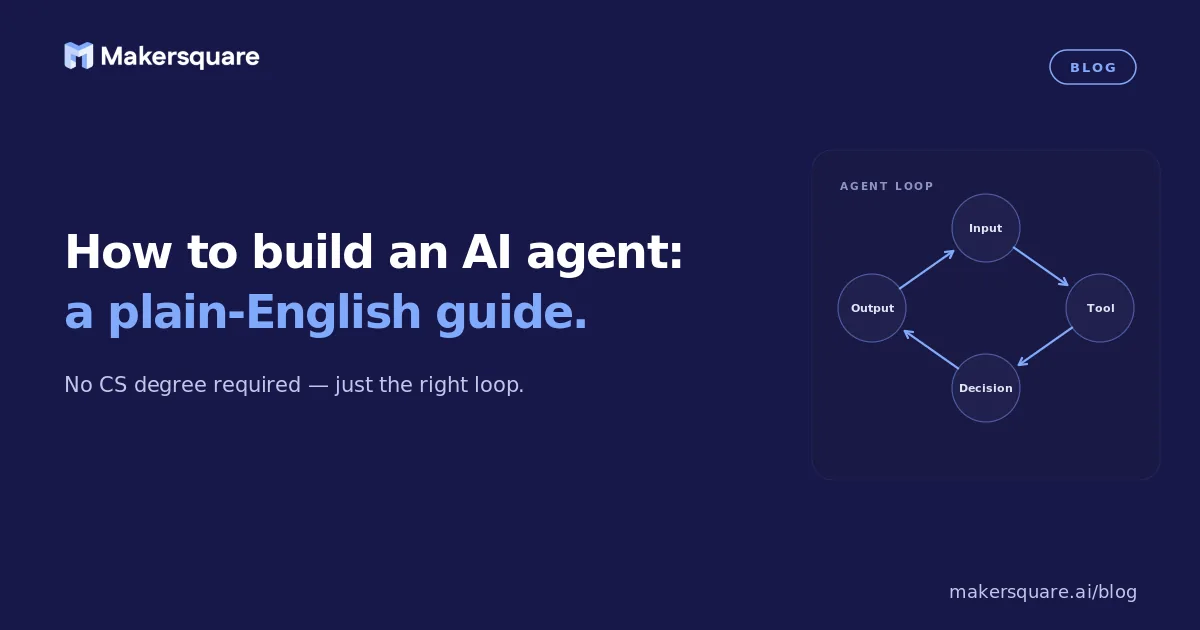
- An AI agent is just a model given a goal, a set of tools, and permission to loop - take an action, see the result, decide the next action - until the goal is met.
- The momentum is real: Gartner expects 40% of enterprise applications to include task-specific AI agents by the end of 2026, up from under 5% in 2025.
- But there's a gap between demo and durable: nearly two-thirds of enterprises have experimented with agents, yet fewer than 10% have scaled them to real value. The difference is scoping.
- You don't need to be an engineer. The hard part of a useful agent isn't the code - it's clearly defining the goal, the tools, and the stopping conditions, which a domain expert is best placed to do.
'AI agent' is one of the most hyped and least clearly explained terms in tech right now. Let's fix that. The direct answer: an AI agent is an AI model that's been given a goal, a set of tools it can use, and permission to work in a loop - taking an action, observing the result, and deciding the next action - until it reaches the goal or hits a stopping condition. That's the whole idea. Everything else is detail.
What an agent actually is (vs. a chatbot)
A regular AI chat answers one question at a time - you ask, it responds, done. An agent is different in one specific way: it can take actions and react to what happens. Give it the goal 'find 20 companies hiring for this role and save them to a list,' plus tools (web search, a place to save data) and a stopping condition (20 companies, or 15 tool calls), and it will search, read results, decide it needs more, search again, and keep going until it's done. The loop - act, observe, decide, repeat - is what makes it an agent rather than a chatbot.
The momentum, and the honest caveat
Agents are the biggest story in enterprise AI. Gartner expects 40% of enterprise applications to include task-specific AI agents by the end of 2026, up from less than 5% in 2025, and nearly 79% of companies report using AI agents in some form. But here's the caveat worth internalizing before you build one: nearly two-thirds of enterprises have experimented with agents, yet fewer than 10% have scaled them to deliver real value. The failures aren't usually technical - they're scoping failures. Agents given fuzzy goals and unlimited latitude wander; agents given a sharp goal, the right tools, and clear limits work.
The four things every useful agent needs
1. A specific goal. Not 'help with marketing' - 'draft a personalized outreach email for each new lead in this spreadsheet.' Vague goals are the number-one reason agents fail.
2. The right tools. An agent is only as capable as the tools you give it - web search, reading a database, sending a draft, running a calculation. Give it exactly what the task needs, no more.
3. Stopping conditions. When is it done, and what's the ceiling? '30 candidates found, or 20 tool calls' keeps it from looping forever or going off the rails. This single guardrail separates reliable agents from expensive runaway ones.
4. A human checkpoint. The best agents do the work and then hand it to a person to approve - especially anything customer-facing. That's not a limitation; it's the design that actually ships.
Why a non-engineer is well-positioned to build one
Notice what the hard part actually is. It's not writing code - modern tools handle much of that. It's defining the goal precisely, choosing the right tools, and setting sensible limits. That's judgment about the work itself, which a person who understands the problem is far better at than a generalist engineer. This is exactly what MakerSquare teaches: our use cases include building working agents around real tasks, scoped tightly enough to actually be trusted.
The people building agents that survive past the demo aren't the best coders. They're the ones who scoped the job so precisely that the agent couldn't help but succeed.
MakerSquare is a 2-week in-person AI builder program in Austin, TX where operators and domain experts build real, working AI agents around their own tasks - scoped tightly enough to actually trust. See what two weeks of hands-on building looks like.