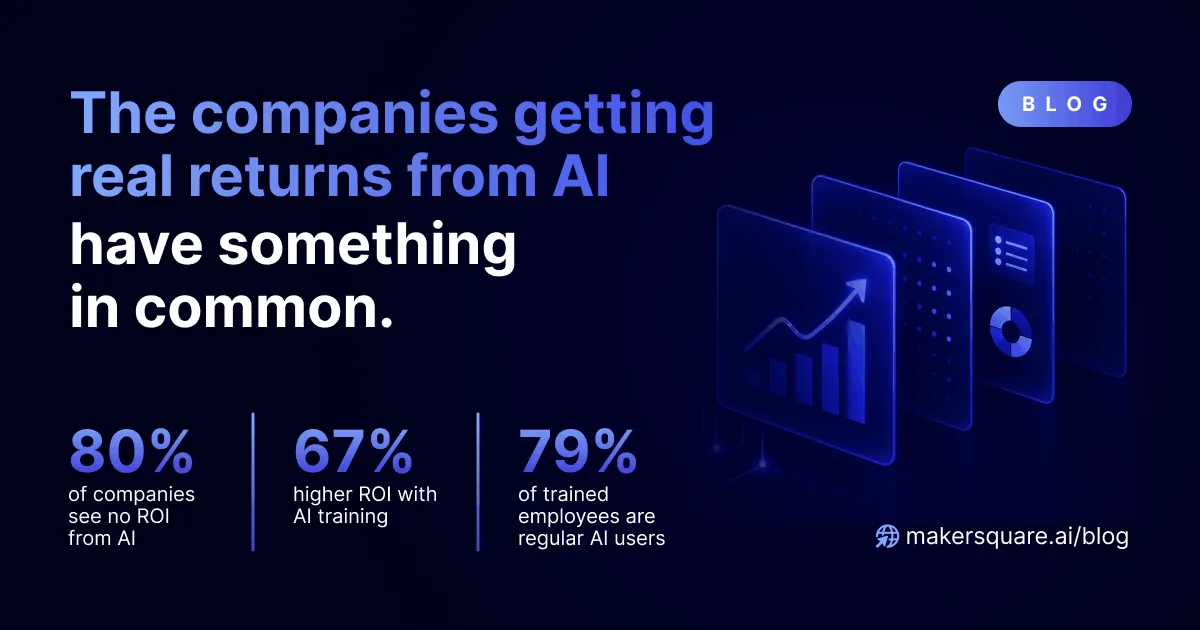
- Over 80% of companies report no measurable AI productivity gains, despite significant investment (G-P, 2026).
- The most consistent reason: organizations deployed tools without investing in AI training for their people.
- Companies with intentional AI training strategies see 67% higher ROI and adopt 2.3x faster than industry peers (BCG, 2026).
- Among professionals with 5 or more hours of AI training, 79% become regular users, vs. 67% with less (BCG, 2026).
Stanford researchers described it plainly at the end of last year: the era of AI evangelism is giving way to an era of AI evaluation. For most organizations, the question is no longer whether AI will change how work gets done. It's why the results are so uneven, and what the companies actually seeing returns are doing differently. For any organization trying to figure out how to get ROI from AI at work, five major 2026 research studies point to the same answer: companies that invest in training their people see dramatically better returns than those that simply deploy the tools and move on.
Why companies aren't seeing ROI from AI
A survey of 6,000 executives conducted by G-P in early 2026 found that over 80% of companies report no measurable AI productivity gains, despite significant AI investment. Goldman Sachs published a similar finding: "no meaningful relationship between AI and productivity at the economy-wide level." The reason isn't hard to find. Most organizations treated AI as a software purchase, not a capability to develop. They bought access to the tools and assumed the results would follow. BCG's research tracks what happens when companies take a different approach. Among organizations with intentional AI training strategies, ROI runs 67% higher and adoption happens 2.3x faster than industry peers.
What the labor market is already signaling
The debate about AI ROI is still open, but companies aren't waiting for it to resolve. Anthropic's March 2026 workforce report found that hiring of 22-to-25-year-olds in roles with high AI exposure slowed 14% over the past year. Organizations that have figured out how to use AI effectively are already adjusting what they pay for and who they bring on, and doing it quietly.
How to get ROI from AI at work: what the data shows
BCG's 2026 AI at Work research offers the clearest answer to the AI investment gap yet. Among professionals who have spent five or more hours on AI training, 79% become regular users. Among those with less than five hours, that figure sits at 67%. The companies in that top 20% are not necessarily the ones with the largest software budgets. They are the ones that gave their people enough time to actually get good at using the tools.
How to actually measure it
Most companies can't tell you whether AI is paying off because they started measuring after they deployed, not before. And they measure the wrong thing: seats active, logins, prompts sent. Those trend up and make the dashboard look good, but an employee who opens Claude every morning to reword an email she'd have sent anyway is "using AI" and producing exactly zero incremental value. If you measure logins, you optimize for logins — and logins don't pay for the tool.
The right unit isn't the session, it's the task. Pick one specific, recurring task that produces a clear output — first-draft proposals, research summaries, meeting prep. Record a baseline: how long it takes and how good it is before anyone touches AI. Then measure the same task again after 30–60 days of consistent use. The three metrics that actually connect to business outcomes are throughput (how much gets done), time-per-task (how fast), and quality (revision cycles, error rates, client feedback) — not sentiment, not usage.
What this means for AI training at work
That gap between tool access and actual capability is what MakerSquare was built around. The program is an in-person AI training for founders, operators, and managers who need to develop a genuine working skill with AI, not just experiment with it. The curriculum is built around the same question the BCG research keeps asking: not whether your team has access to the tools, but whether they can actually use them to get real work done.
Most organizations measure AI adoption by licenses purchased and tools deployed. The ones seeing returns shifted that metric to something harder to fake: can our people actually use this to get real work done?
MakerSquare is built around exactly this gap — in-person AI training for operators, founders, and managers who need to actually get good at using these tools.