- AI is reshaping tasks more than eliminating roles. The risk is not that your job disappears overnight — it's that it becomes a half-job that pays a half-salary.
- The roles under the most pressure share a pattern: they involve high volumes of information processing that AI can now replicate at near-zero cost.
- The response that actually works is not 'learn to code' — it's developing enough AI skill to do your existing work faster and to handle the higher-judgment tasks that AI handles less well.
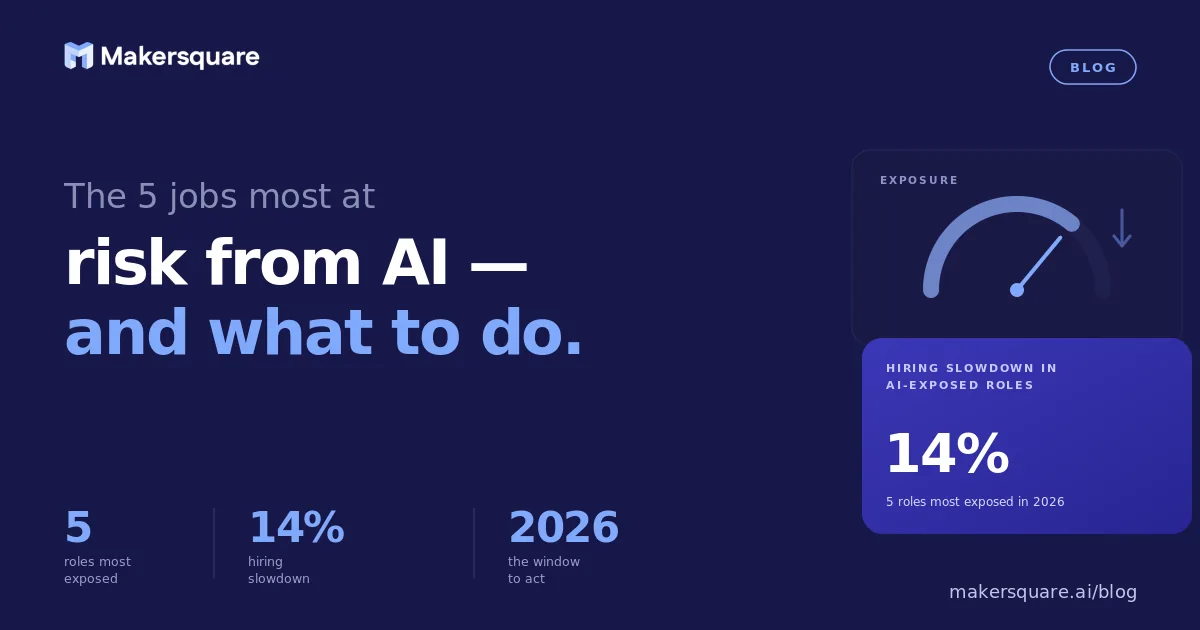
- Anthropic's 2026 labor market data found hiring in high AI-exposure roles already slowed 14% — the risk is not theoretical and it is not five years away.
The AI displacement conversation tends to produce one of two failure modes: panic about robots taking everything, or dismissal that nothing real is happening. The data from 2026 suggests neither is accurate. What's actually happening is more specific: particular tasks within particular roles are being automated, and the roles that carry the most task-level risk are already seeing labor market pressure. The five categories below are where that pressure is most concentrated — and what responding effectively looks like in practice.
How to think about AI risk: tasks, not titles
The first thing to understand about AI job displacement is that it operates at the task level, not the role level. Your job title is a collection of tasks. Some of those tasks — the ones that involve pattern recognition, information synthesis, template execution, and routine communication — are increasingly within AI's capability range. The tasks that require contextual judgment, relationship management, novel problem framing, and organizational authority are not.
Anthropic's 2026 labor market report found that 75% of programmer tasks now have AI coverage. That doesn't mean 75% of programmers are at risk of losing their jobs. It means programmers who only do the tasks AI can replicate are at risk, while programmers who focus on architecture, problem framing, and oversight of AI-generated code are more valuable than before. The same logic applies across every category below.
The 5 roles facing the most pressure
Data entry and reporting roles. Any role whose primary function is moving data between systems, generating recurring reports from templates, or maintaining records that don't require contextual judgment is highly exposed. These are the tasks AI automation handles most reliably — the pattern is well-defined, the output is verifiable, and the volume justifies the setup cost.
Junior copywriters and content producers. First-draft content generation is now a commodity. The roles that face pressure are those where 'generating content' is the primary value being delivered, not the judgment about what to create, who it's for, and whether it's working. Senior content strategy, creative direction, and brand judgment are much less exposed.
Basic customer support. Tier-1 support — answering frequently asked questions, processing routine requests, routing issues — is being automated at scale. The roles that remain are those handling escalated, emotionally complex, or high-stakes interactions that require genuine human judgment and authority to resolve.
Junior financial analysts. Collecting data, building standard models, generating variance reports, and producing first-draft investment summaries are all within AI's current capability range. Senior analysts who interpret context, build client relationships, and exercise investment judgment are in a different position.
Administrative coordinators. Scheduling, inbox management, document preparation, and travel logistics — the core of many coordinator roles — have extensive AI tooling. The coordinators who have high job security are those who have developed expertise in the judgment layer: knowing who actually needs to be in the room, what the real constraints are, and how to navigate organizational complexity.
What 'staying ahead' actually requires
The response that doesn't work: waiting to see what happens. The Anthropic data on hiring slowdowns suggests the adjustment is already underway, and it's happening quietly enough that most professionals won't notice until they're interviewing for a role that used to be straightforward and finding more competition than they expected.
The response that works: developing enough AI skill to do your existing tasks faster and to move toward the higher-judgment work in your role that AI handles less well. BCG's research on the cost of waiting is specific: five hours of structured AI practice is the threshold at which professionals become consistent users. Below that, most people are dabbling. Above it, they're building genuine capability.
The pattern in every category above is the same: the tasks at risk are the ones that can be reduced to a clear input-output relationship. The tasks that survive are the ones requiring judgment — knowing what actually matters, why, and for whom. Developing AI skill doesn't just protect you from displacement; it accelerates your move toward the judgment-layer work that AI augments rather than replaces.
MakerSquare is built specifically for the professionals in these categories — founders, operators, managers, and knowledge workers who need to develop genuine AI capability without a technical background. The two-week program is structured to actually move that skill threshold.