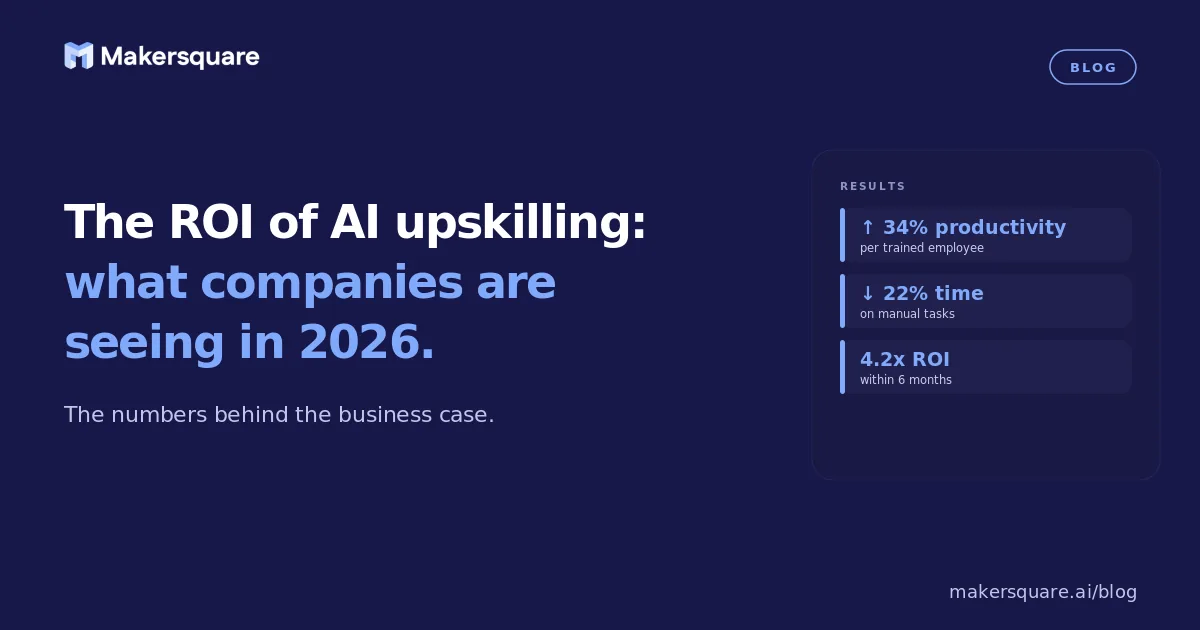
The AI upskilling ROI question is no longer theoretical. Enough companies have run enough programs with enough rigor to have real data. The answer isn't a single number — it depends enormously on what you define as "upskilling," who you train, and whether the training changes how people actually work. But the patterns are clear enough to be actionable.
This post covers what the research shows, what companies are actually measuring, and what separates the programs that deliver returns from the ones that produce completion certificates and nothing else.
- BCG's AI at Work research: employees with 5+ hours of structured AI training are 25% more likely to be regular AI users.
- MIT's 2024 controlled study: AI-assisted workers completed tasks 25.1% faster with 40% quality improvement.
- Productivity gains are most measurable on high-frequency, knowledge-work tasks — writing, analysis, research, reporting.
- Training ROI is destroyed when there's no workflow change after the session ends. Knowledge without practice produces nothing.
- The best indicator of upskilling ROI: whether AI tool adoption rate increased, not whether employees completed training.
What the research actually shows
The most rigorous study on AI's productivity impact comes from MIT's Digital Economy Lab. In a controlled 2024 experiment, professionals using AI assistance completed business writing tasks 25.1% faster than control groups, and independent graders rated the AI-assisted work 40% higher in quality. Crucially, the largest gains went to lower-performing workers — AI leveled up the bottom of the distribution more than the top.
BCG's "AI at Work" research series, which surveys thousands of knowledge workers annually, found that the threshold for durable AI adoption is more than five hours of structured practice. Employees who received fewer than five hours of training had adoption rates similar to those who received no training. The implication: short awareness sessions don't move the needle. Most corporate "AI training" falls well below the threshold where it changes behavior.
Accenture's 2025 workforce AI study found that companies in the top quartile of AI adoption reported 30% higher revenue growth than those in the bottom quartile — but noted that the gap between top and bottom quartile has widened, not narrowed, over the past two years. Adoption isn't spreading evenly. The companies investing in structured, applied upskilling are pulling ahead; the ones relying on organic adoption or minimal training are falling behind.
How to measure AI upskilling ROI — the right way
Most companies measure training ROI wrong. They track completion rates ("87% of employees completed the AI module"), satisfaction scores ("average 4.2/5 rating"), and occasionally self-reported confidence levels. None of these measure whether behavior changed.
The metrics that actually indicate ROI:
AI tool adoption rate. What percentage of trained employees are using AI tools at least weekly, 90 days after training? This is the primary indicator. If adoption didn't increase, the training didn't work — regardless of completion rates or satisfaction scores. Track this at 30, 60, and 90 days post-training.
Task-level time savings. For two or three high-frequency tasks in the trained role, measure time-on-task before and after training. A marketing team member who drafts client reports weekly provides a clean before/after comparison. A quantified time saving converts directly to an ROI calculation.
Output volume and quality. Does trained staff produce more, faster, at the same or higher quality? This is harder to measure cleanly but meaningful when you can isolate the variable. Companies with output metrics pre-training (reports produced, deals worked, tickets resolved) can measure this directly.
Retention and engagement signals. Companies investing significantly in AI upskilling often report secondary retention benefits: LinkedIn Workplace Learning survey data shows AI and tech skills top the list of what employees cite as reasons they stayed at an employer. This benefit is real but harder to attribute directly to upskilling spend.
What separates high-ROI programs from low-ROI programs
The structural difference between AI training programs that deliver returns and those that don't comes down to four factors:
Applied practice time. Programs that require participants to use AI on their actual work — not hypothetical scenarios or generic examples — produce dramatically higher adoption rates than programs that demonstrate AI capabilities and leave practice as "homework." Practice has to be built into the program, not optional. The BCG five-hour threshold applies to structured, applied practice, not passive learning.
Role specificity. Generic "AI fundamentals" training teaches people what AI is. Role-specific training teaches them what to use AI for in their actual job. A program that shows a finance team member exactly how to use AI for their specific reporting and analysis tasks produces better adoption than a program that covers general AI capabilities across all functions. The more specific the training, the faster the translation to workflow change.
Accountability mechanisms. Programs with no follow-through — no check-ins, no peer accountability, no leadership visibility into adoption — lose most of their impact within 60 days. The half-life of training without reinforcement is short. Programs that build accountability into the structure (cohorts, regular practice reviews, team adoption tracking) maintain their impact significantly longer.
Leadership modeling. Employees are much more likely to change how they work if their direct manager is visibly using AI. BCG found that having an AI-active manager is one of the strongest predictors of individual AI adoption. Companies that train only individual contributors without investing in leadership adoption undermine their own programs.
The retention angle: often overlooked, increasingly significant
Most ROI calculations for AI upskilling focus on productivity — time saved, output increased. The retention impact is real but often excluded from the calculation.
LinkedIn's 2025 Workplace Learning Report found that employees who feel their company invests in their development are 3.5x more likely to stay. AI skills are at the top of the list of development investments employees want from employers. In a tight labor market for knowledge workers, the replacement cost of losing a skilled employee — typically 50–200% of annual salary — is often larger than the entire cost of the training investment.
Including realistic retention impact in ROI calculations typically makes the AI upskilling business case stronger, not weaker. An AI program that saves 10 hours per month per trained employee generates modest but real productivity returns. If it also retains one additional senior employee who would otherwise have left, the total ROI may be multiples higher.
A realistic ROI calculation for a mid-size company
Here's a worked example for a company that sends 20 employees through meaningful AI upskilling (10+ hours of applied training, role-specific, with accountability):
- Training cost: $4,000–$10,000 per person (intensive, applied programs) = $80,000–$200,000 total
- Conservative time savings: 5 hours per week per trained employee on high-frequency tasks = 100 hours per week across the team
- Value of time saved: At $75/hour blended rate = $7,500 per week = $390,000 per year
- Payback period: 3–6 months on productivity alone
- Retention value: If training retains 1–2 employees who would otherwise have left, add $75,000–$300,000 in avoided replacement costs
These numbers are conservative. They assume modest time savings (5 hours per week is lower than what most intensive programs report) and a low hourly rate. At $100+/hour blended rates and 10+ hours of weekly savings — which is common for senior knowledge workers — the payback period drops to 6–8 weeks.
The caveat: these returns require training that actually changes behavior. Awareness training, lunch-and-learns, and one-hour webinars don't generate these numbers because they don't produce durable workflow change.
What companies are doing differently in 2026
The companies reporting the strongest AI upskilling ROI in 2026 share a few common approaches that were less common two years ago:
- Sending cohorts, not individuals. Team-based programs create peer accountability and shared vocabulary that persists after training ends. Solo training produces isolated adoption that struggles to become team culture.
- Measuring adoption, not completion. Companies tracking and reporting on AI tool adoption rates post-training get better results because adoption is what gets managed. What you measure improves.
- Investing in managers first. Companies that train managers before individual contributors — and track whether managers are modeling AI use — see significantly higher individual adoption rates.
- Building internal showcases. Regular internal demonstrations of how AI has changed real work (not hypotheticals) are one of the most effective organic adoption accelerants. Seeing a colleague's specific before/after is more compelling than any training session.
MakerSquare is a 2-week in-person AI builder program in Austin, TX — built for operators, founders, and professionals who want to build real AI tools, not just use them. Companies sending teams to MakerSquare do so because they want genuine workflow change — not training completion certificates. The 2-week format, with daily applied practice on participants' actual work, consistently crosses the BCG five-hour threshold within the first three days. See what companies are sending teams for at makersquare.ai/corporate.
MakerSquare sends teams home with skills they use the next day — not certificates. Two weeks, in-person, Austin TX.