- Using AI and building with AI are two distinct skill levels — one produces one-time outputs, the other creates systems that produce outputs repeatedly.
- Builders don't need to know how to code. The core skill is problem decomposition: understanding what you need to automate clearly enough to describe it.
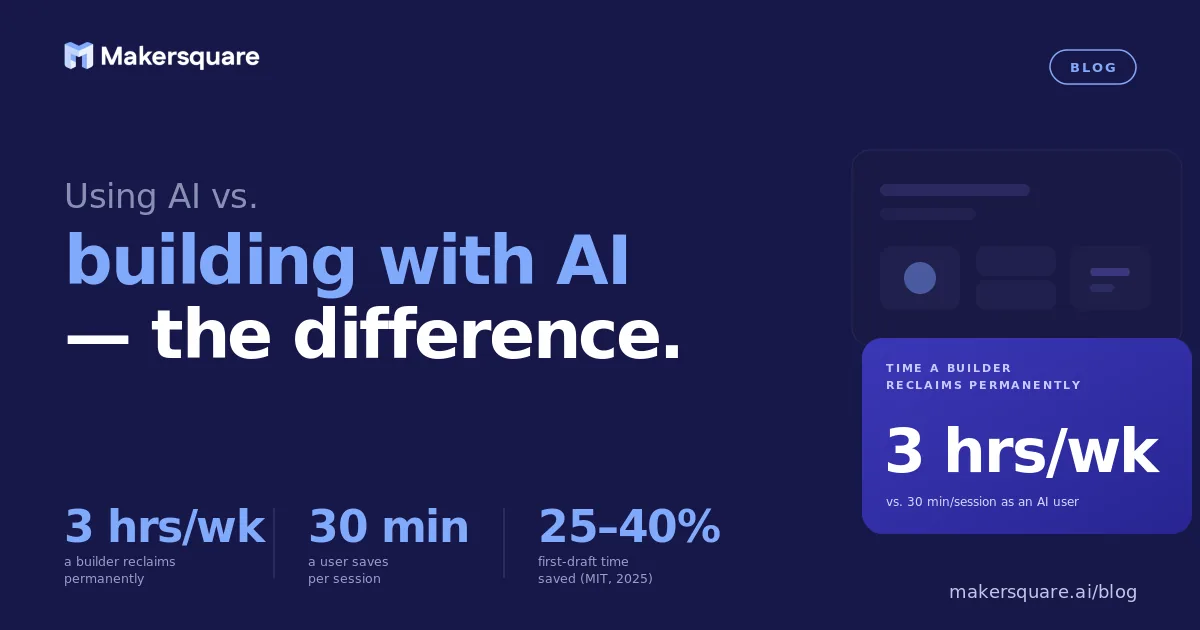
- The compounding advantage of building versus using is dramatic: a builder who automates a recurring 3-hour task reclaims those hours every week. A user saves 30 minutes each time.
- BCG research shows that employees who move beyond basic AI use to applied, structured practice see dramatically different productivity outcomes — the jump from user to builder is where the real returns live.
Most of the conversation about AI right now is about using it — better prompts, better tools, better workflows. That conversation is useful. But there's a second conversation that's happening more quietly among the people who are actually pulling ahead: the difference between using AI and building with AI.
Using AI vs building with AI isn't a technical distinction. It's a strategic one. And it's the single biggest determinant of who will be structurally ahead in two years versus who will still be doing the same tasks the same way, just slightly faster.
What using AI looks like
Using AI means you interact with AI tools to complete tasks. You open Claude, write a prompt, get an output, refine it, use it. You do this for emails, for research, for first drafts, for summarizing documents. Each time you use it, you get something useful. Each time is also a fresh start — you bring the context, you guide the process, you evaluate the output.
This is genuinely valuable. Research from MIT in 2025 found that knowledge workers using AI on appropriate tasks cut first-draft time by 25-40% on average. If you're writing 10 documents a week and each one takes you half the time it used to, you have reclaimed real hours. That's not nothing.
But it has a ceiling. The efficiency gains from using AI are fundamentally additive. Each instance of using AI saves some time on that instance. The time saving doesn't compound. The process doesn't get better on its own. Next week you'll run the same prompt for the same kind of document and save roughly the same amount of time.
What building with AI looks like
Building with AI means creating a system — a tool, a workflow, an automated process — that uses AI to solve a recurring problem without requiring you to re-do the work each time. Instead of asking Claude to summarize competitor news every Monday morning, you build a tool that pulls the news, runs the summary, and delivers it to your inbox automatically. You do the work once. The system runs indefinitely.
This doesn't require coding in the traditional sense. Tools like Claude, Cursor, and Replit now let non-technical people describe what they want to build and get working code in return. The skill that matters is not syntax. It's problem decomposition: understanding what you need clearly enough to describe it, what the inputs and outputs should be, what "good" looks like. That's a professional skill. It's the same thing a good project manager or operator already does.
Anthropic's 2026 workforce research identified operators and knowledge workers as the professionals with the highest potential AI leverage — specifically because their work involves structured, recurring processes that are well-suited to automation. The constraint is not that their work can't be automated. It's that most of them have only learned to use AI, not build with it.
Why the distinction matters more than it seems
The compounding math is where the real difference lives. A consultant who uses AI to help write client reports saves maybe 45 minutes per report. A consultant who builds an AI tool that structures, pulls from previous reports, integrates client data, and generates a first-pass report in five minutes has not just saved time — she has changed the economics of her practice. She can take more clients, or invest those hours in relationship work that actually grows the business.
This plays out across industries. A sales manager who uses AI to write follow-up emails saves some time per email. A sales manager who builds an AI tool that pulls CRM context, identifies the right follow-up timing, and drafts role-specific emails for each lead has built something with leverage. One is a productivity tool. The other is a competitive advantage.
BCG's research on AI ROI found that organizations where employees had moved from basic use to applied, structured AI work saw dramatically different outcomes — 67% higher ROI than peers who had only deployed tool access. The jump from user to builder is where those returns come from.
What this means for professionals who want to stay ahead
The practical question is: how do you develop builder skills if you're not technical? The honest answer is that it takes more than experimenting with ChatGPT for a few weeks. It requires learning to think in systems — identifying recurring problems, designing solutions, testing and iterating on them. That's teachable. It's not innate.
MakerSquare is a 2-week in-person AI builder program in Austin, TX — we work with operators, founders, and professionals who want to build real AI tools, not just use them. Every student leaves with real, working AI tools they built during the program. The curriculum is built around the builder mindset: what problem are you solving, what does the tool need to do, how do you know it's working?
Using AI is a skill worth having. Building with AI is a different and more durable advantage — one that compounds over time in a way that using never will.
MakerSquare is built around the builder mindset — 2 weeks in person in Austin, and you leave with deployed AI tools. See what students build and how the program is structured.