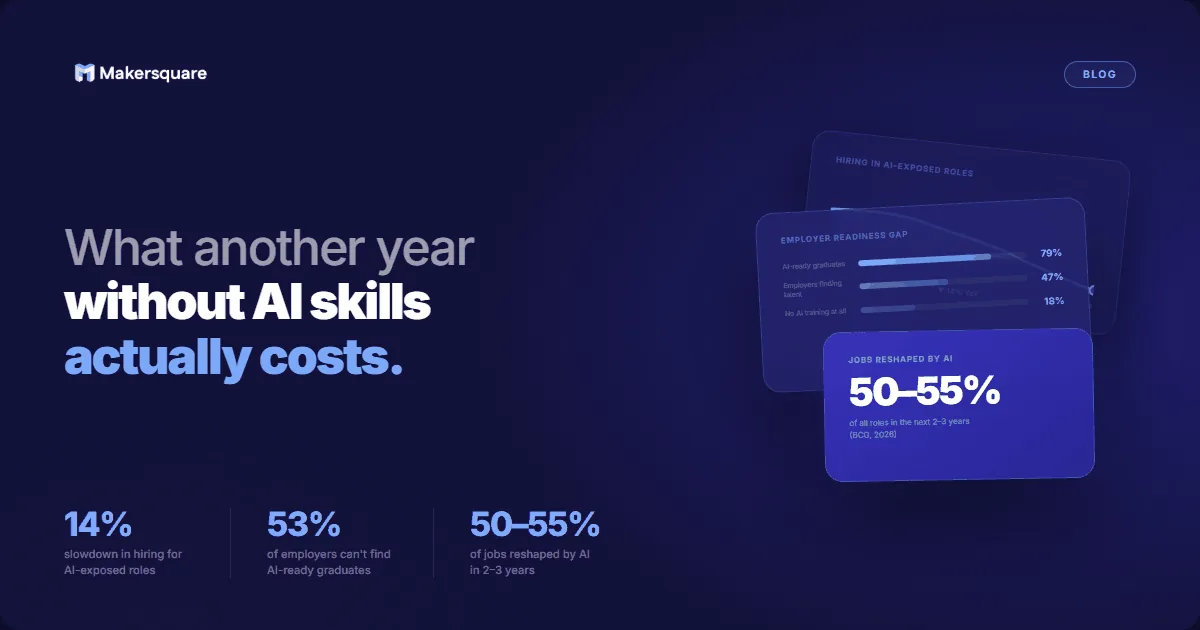
- Hiring of 22-to-25-year-olds in high AI-exposure roles slowed 14% in a single year. The market is already adjusting (Anthropic, 2026).
- 53% of employers report struggling to find graduates with the right AI skills (Pearson, 2026).
- BCG projects 50 to 55% of jobs will be reshaped by AI within two to three years. Not eliminated, but reshaped.
- The gap between AI-skilled and AI-adjacent professionals is widening faster than most people expect.
Most professionals know AI is changing things. The uncertainty isn't about whether the shift is real. It's about timing: how urgent is it, really, and what does another year of waiting actually cost? In concrete terms: slower hiring, narrower internal opportunities, and peers who have already pulled ahead. The data from 2026 is specific enough now to be direct about this. The cost of not learning AI skills shows up in two places, hiring and positioning, and neither is hypothetical anymore.
The labor market shift most professionals are misreading
Anthropic's March 2026 labor market report tracked something that rarely surfaces in broader AI coverage. Hiring of 22-to-25-year-olds in roles with high AI exposure slowed 14% over the past year. That's not because those roles disappeared. It's because companies that have figured out how to use AI effectively are adjusting what they pay for and who they bring on, and they're doing it quietly. The signal isn't dramatic. It doesn't look like mass layoffs or a sudden shift in job postings. It looks like a gradual narrowing of who gets the interview.
The same report found that 75% of programmer tasks now have AI coverage, meaning AI tools can handle a meaningful portion of what entry-level technical roles were hired to do. The implications extend well beyond programming. Any role where a significant share of the work involves information processing, writing, analysis, or routine decision-making is facing a version of the same pressure.
What employers are finding when they search for AI skills
Pearson surveyed employers in 2026 and found that 53% struggle to find graduates who are genuinely AI-ready. Not graduates who list tools on a resume. Graduates who can actually apply AI reliably to real work. That gap is creating real pressure inside organizations: teams that want to move faster with AI can't, because the people they're hiring haven't developed the skill yet. The shortage isn't in AI engineers. It's in the operators, managers, and knowledge workers who can use these tools well enough to change how their team functions. For a deeper look at what that gap costs organizations specifically, see what the data shows about AI ROI at the organizational level.
The cost of waiting to learn AI skills
Waiting another year means entering a job market that has already started to narrow, and an internal one where AI-skilled peers are pulling ahead. BCG's 2026 projections put the pace of change in concrete terms: 50 to 55% of jobs will be reshaped by AI within two to three years. That's a short window. And the word "reshaped" matters. These roles aren't going away. The tasks that make them up are changing. Professionals who develop AI capability now have input into how their role evolves. Those who wait are more likely to have that decision made for them.
BCG's research also found that companies where employees have strong AI skills achieve 67% higher ROI and adopt AI 2.3x faster than industry peers. That gap doesn't stay theoretical. It becomes visible in performance reviews, in who gets the high-stakes projects, in who gets promoted when the organization restructures around AI workflows.
What acting now actually looks like
The encouraging part of the Pearson finding is what it implies: the bar for being AI-ready is not as high as most people assume, because almost no one has cleared it. 53% of employers can't find what they're looking for. That's not a crisis of people who tried and failed. It's a crisis of people who haven't tried yet.
BCG's AI at Work research found a meaningful threshold at five hours of structured practice: 79% of professionals who crossed it became regular AI users, compared to 67% of those who hadn't. The difference isn't months of learning. It's focused time spent moving from experimenting with tools to using them on real work.
What that practice looks like matters. The professionals who cross that threshold aren't watching tutorials. They're applying AI to the actual tasks their job requires: drafting client communications, synthesizing research, restructuring how they handle recurring decisions. The tools are secondary. The skill being built is judgment: knowing when to use AI, how to direct it, and how to close the gap between a first output and something actually useful. That judgment is what employers can't find on a resume, and what peers who started a year ago have already developed.
The cost of not building AI skills for work isn't a single moment where things go wrong. It's a slow accumulation: the project that goes to someone else, the promotion that goes to the person who can demonstrate AI-driven output, the restructuring where the roles that remain are the ones attached to people who already know how to work this way. That's what another year of waiting actually costs.
That's the gap MakerSquare was built for. The program is two weeks of in-person AI training for founders, operators, and managers. Not a survey of tools, but enough structured practice to actually move the needle on how you work. The curriculum is built around the tasks professionals actually need to do faster: research, writing, analysis, decision-making. The cohort model means you're not learning in isolation. You're working through it with a room of people who are figuring out the same problems in their own organizations.
The window where AI skills are a differentiator is closing. Once most professionals have basic AI capability, having it won't stand out. Not having it will. MakerSquare is two weeks, in person, in Austin.