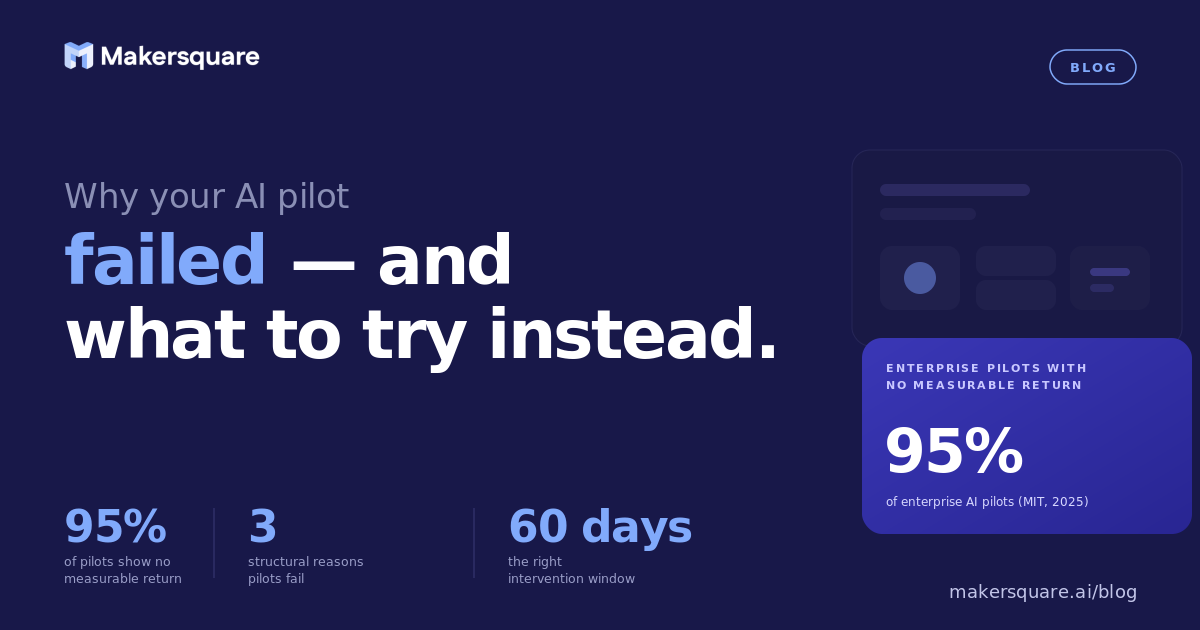
- Most AI pilot programs fail for the same structural reasons — not because of the technology, but because of how the pilot was designed.
- The three most common failure modes: scoped too broadly, measured the wrong thing, and ended before behavior change had time to take hold.
- MIT research puts the share of enterprise AI efforts with no measurable return as high as 95% — the pilot model is a big reason why.
- The alternative isn't a bigger pilot. It's a narrower one: one team, one task, one tool, 60 days, with a clear before/after measure.
Most companies running an AI pilot right now have already run one before. And the reason they're running another one is that the last one didn't produce anything they could point to. Not because AI doesn't work — but because AI pilot programs fail in predictable ways that have nothing to do with the technology itself.
The reason AI pilot programs fail is almost never the AI. It's the pilot design. Three structural mistakes show up again and again, and they're all fixable before you launch the next one.
Mistake 1: Scoped too broadly to produce a clear result
The typical AI pilot looks like this: fifteen employees across three departments get access to a tool for eight weeks, with instructions to "explore how AI can help your work." That's not a pilot. That's a license experiment. And it produces exactly what you'd expect: some people use it, some don't, and at the end you have anecdotes instead of data.
A real pilot has a specific hypothesis. Something like: "If our proposals team uses Claude to draft first-pass client proposals, we expect turnaround time to drop from 3 days to 1 day." That's specific enough to test. You can measure it before, run the intervention, and measure it after. Broad pilots don't have hypotheses — they have hopes.
MIT research found that 95% of enterprise AI efforts show no measurable P&L return. That number isn't saying AI doesn't work. It's saying that most AI rollouts are not designed to produce a measurable result. The pilot scoping is the first place that goes wrong.
Mistake 2: Measuring the wrong thing
The second failure mode is measuring engagement rather than outcome. How many people logged in. How many prompts were sent. Whether employees reported feeling positive about the tool in a post-pilot survey. These metrics feel like evidence of progress, but they don't tell you whether the tool changed how anyone works.
The only measurement that matters in an AI pilot is whether the specific outcome you set out to change actually changed. Did proposals turn around faster? Did the research process produce better output? Did a task that took three hours now take one? If you can't answer that question with a number, the pilot measured the wrong thing.
This is a subtle but important distinction. An employee who logs into Claude every day but uses it to rewrite emails they would have sent anyway has "adopted" the tool by engagement metrics. But nothing has changed about how their work gets done. BCG's research makes this concrete: the differentiator between high-ROI and low-ROI AI deployments is whether employees developed genuine capability — not whether they had access to the tools.
Mistake 3: Ending before behavior change has time to take hold
The third mistake is duration. A four-week AI pilot, with light usage and no accountability structure, is measuring first impressions. It is not measuring whether people changed how they work. Changing how you work takes longer than four weeks — it takes repeated practice on real tasks until the new approach becomes faster and more natural than the old one.
BCG's research puts the threshold for regular AI adoption at five or more hours of structured, applied practice. For most employees in most pilots, that doesn't happen in four weeks of light usage. The pilot ends before they've crossed the threshold where the tool starts saving time rather than costing it. Then the result gets logged as "not a fit" when the real result was "not enough time."
What to try instead of a broad AI pilot
The fix isn't a bigger pilot. It's a narrower one. Pick one team. Pick one specific, recurring task that team does every week. Pick one tool. Give them 60 days — not four weeks, not eight weeks of optional exploration, but 60 days of doing that specific task with AI as the default approach. Measure the task time at the start. Measure it again at the end.
That produces something you can act on. Either the task got faster, in which case you have a model to expand. Or it didn't, in which case you have specific information about why — was it the task, the tool, the prompting approach, or the fact that some tasks genuinely aren't well-suited to AI yet?
MakerSquare is built around this philosophy. The program curriculum is structured around building and shipping real AI tools in two weeks — not experimenting with tools in the abstract, but producing working things that solve specific problems. The same principle that makes our program work applies to corporate AI pilots: specificity produces results. Breadth produces confusion.
If your last AI pilot failed, it almost certainly failed in one of these three ways. The next one doesn't have to.
MakerSquare is a 2-week in-person AI builder program in Austin, TX — built around the same principle: specificity produces results. See what students build and how the program is structured.