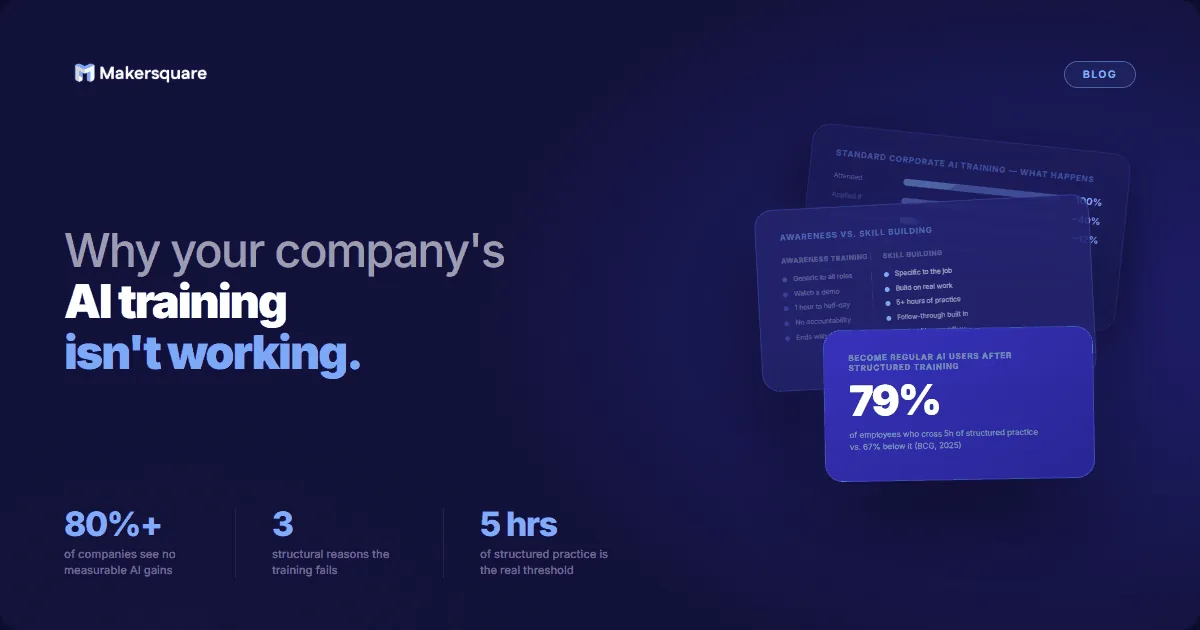
- Over 80% of companies report no measurable AI productivity gains despite significant investment — and an MIT study puts the share of enterprise AI efforts with no measurable return as high as 95%.
- Most corporate AI training fails for three structural reasons: it's too generic, too passive, and there's no accountability after the session ends.
- The distinction that matters is not awareness vs. ignorance — it's awareness training vs. skill building. Most companies have only done the first.
- BCG found that 79% of employees who received more than five hours of structured training are regular AI users, compared with 67% of those who received less. The differentiator is structure, not content.
Ask almost any L&D leader at a mid-sized company whether they've addressed AI training, and the answer is yes. They did a lunch-and-learn. They bought licenses for an AI tool and sent an onboarding email. They ran a half-day workshop on prompt basics. In the data, this shows up as "AI training completed." In practice, it shows up as the same finding we covered in how to get ROI from AI at work: over 80% of companies seeing no measurable AI productivity gains, despite significant investment.
The failure is not a content problem. Most AI training materials are reasonably accurate about what the tools do. The failure is structural — three specific structural problems that make almost all corporate AI training predictably ineffective.
Problem 1: It's too generic to apply
The standard corporate AI training experience teaches employees about AI. It covers how large language models work, what tools exist, what prompting is, and why this matters. What it rarely covers is how to use a specific AI tool to do a specific task that a specific employee actually does on a given Tuesday.
The gap between "I understand what AI is" and "I know how to use it to do my actual job faster" is where most programs stop. A marketing manager who learns about prompt engineering in the abstract still has to figure out, on her own, how to apply that to the email campaigns, creative briefs, and campaign reporting she does every week. Most don't make that translation. The generic training stays generic.
Problem 2: It's passive, not practice-based
Learning to work with AI is more like learning to cook than learning a fact. You can watch every cooking demonstration ever filmed and still not know how to cook. The only thing that builds the skill is doing it — on real ingredients, under real time pressure, with someone to tell you where you went wrong.
Corporate AI training, in most formats, is watching the demonstration. Employees attend the session, see what the tools can do, and leave without having built anything themselves. BCG's AI at Work research found a meaningful threshold at five hours of structured practice: 79% of employees who crossed it were regular AI users, compared with 67% of those who didn't. Most corporate training programs don't come close to that threshold, and the practice that does happen is usually low-stakes and disconnected from real work.
Problem 3: Nothing is accountable after the session ends
The third problem compounds the first two. Even when employees leave a training session interested and motivated, there's typically no structure waiting for them on the other side. No deadline to apply what they learned. No one checking whether they tried it. No peer group to compare notes with. The course stays in the learning management system. Work continues. The skill doesn't compound.
This is the same structural problem that explains why self-paced online courses have completion rates under 15%. When there's no external structure creating accountability — no cohort, no deadline, no visible consequence for stopping — most motivated people eventually stop. Corporate AI training has the same dynamic, compressed into a single session instead of a multi-week course.
The distinction most companies miss: awareness vs. skill
There's a more fundamental issue underneath all three. Most organizations conflate two different things: awareness training and skill building. These are not points on a spectrum. They are different interventions with different designs, different time requirements, and different outcomes.
Awareness training is appropriate when the goal is to make employees comfortable with a topic, reduce fear or resistance, and create a shared vocabulary. It's an hour to a half-day. It's valuable. It's also not enough to change how anyone works.
Skill building requires practice on real tasks, feedback on that practice, iteration, and enough time to develop genuine judgment — knowing when to use AI, how to direct it, and how to evaluate whether the output is actually useful. BCG's research puts the floor for this at five hours of structured, applied practice. Not five hours of watching demonstrations. Five hours of building, failing, iterating, and building again.
The companies pulling ahead are not the ones that did more awareness training. As BCG's own conclusion puts it, strategy matters more than tools: the organizations seeing measurable impact designed their programs around skill building from the start — specific role applications, required practice time, accountability structures, and an outcome measured in changed workflows rather than completed modules.
If you ran a pilot instead of a training program
Some companies skip training and run a pilot instead — hand a tool to a group for a few weeks and see what happens. Pilots fail for the same structural reason training does: they're designed around access, not outcomes.
The typical pilot gives fifteen people across three departments a tool for eight weeks and asks them to "explore how AI can help." That's not a pilot, it's a license experiment — some people use it, some don't, and you end up with anecdotes instead of data. A real pilot has a hypothesis specific enough to test: "if our proposals team uses AI to draft first-pass proposals, turnaround drops from 3 days to 1." You measure it before, run it, and measure it after.
The other two ways pilots die: measuring engagement (logins, prompts sent) instead of whether the work actually changed, and ending before the new behavior has had time to stick. MIT found up to 95% of enterprise AI efforts show no measurable P&L return — not because the tools don't work, but because almost nothing is designed to produce a result you can measure. The fix isn't a bigger pilot. It's a narrower one: one team, one task, one tool, 60 days, with a clear before-and-after number.
What asking the right questions looks like
Before investing in an AI training program, three questions separate awareness programs from skill-building ones:
What does an employee produce by the end? If the answer is "a certificate" or "a score on a quiz," the program is awareness-focused. If the answer is "a workflow they built, a tool they deployed, a task they now do faster," it's skill-focused.
How many hours of applied practice does it require? Below five hours of structured practice, BCG's data suggests you're likely below the threshold where regular adoption kicks in. One hour of AI basics won't move the adoption number.
What happens after the training ends? Effective programs build in follow-through: a peer group, a manager who's accountable for seeing the skills applied, a follow-up check-in at 30 days. Programs that end when the session ends usually do too.
Most organizations aren't failing at AI training because they've found the wrong content. They're failing because they've designed programs around the wrong goal — informing employees instead of changing how they work. The fix isn't a better slide deck. It's a different kind of intervention.
MakerSquare's corporate cohort model is built around that distinction. Two weeks of applied, in-person AI work — specific to the tasks your team actually does, with accountability built into the format and a project shipped by the end. The curriculum is transparent about what that looks like in practice.
Rolling AI out across a team? See MakerSquare's AI training for teams and employees — custom programs built around your workflows and tools.
MakerSquare runs corporate AI cohorts for teams of 4 to 15. Two weeks, in person in Austin, with a project shipped by the end. If you're evaluating AI training options for your organization, the curriculum outlines exactly what the program covers and how it's structured — or reach out directly to talk through whether it's the right fit.