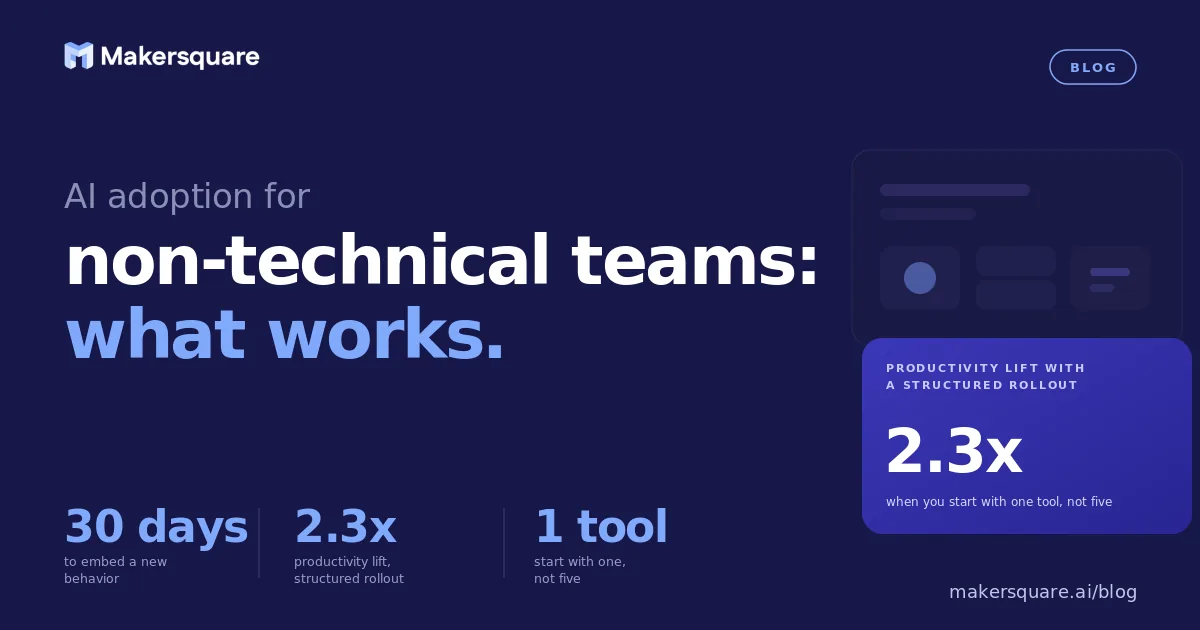
- Non-technical teams don't need a different kind of AI — they need a different kind of rollout. Access-first strategies consistently underperform structure-first ones.
- The three things that separate successful AI rollouts: specific use cases, more than five hours of applied practice, and peer accountability structures.
- BCG research shows that companies with intentional AI training strategies achieve 67% higher ROI and adopt 2.3x faster — this is especially relevant for non-technical teams where self-directed learning stalls out fastest.
- Starting with a problem your team already cares about — not a feature of the tool — is the fastest path to genuine adoption.
Most AI rollouts for non-technical teams fail at the same point: the initial excitement. There's a kickoff, a demo, maybe a workshop. People are interested. Then they go back to their desks and... mostly don't use it. Not because they're resistant. Because "explore what AI can do for you" is not actually an instruction they can follow.
The right AI adoption strategy for non-technical teams is not about finding a simpler tool or a shorter tutorial. It's about designing the rollout itself differently — with the specificity, structure, and accountability that make behavior change stick. Here's what that looks like.
What fails: the access-first approach
The most common approach to AI adoption looks like this: procure licenses, announce the rollout, provide some introductory materials, and wait. This is the access-first approach, and it's the approach that produces the "over 80% of companies reporting no measurable productivity gains" finding from G-P's 2026 survey of 6,000 executives.
The assumption behind access-first is that the limiting factor is tool availability. Once people have the tool, they'll figure out how to use it. This assumption is wrong for most non-technical teams. The limiting factor is not access — it's the absence of a clear starting task, a peer group to learn alongside, and enough structured practice time to develop actual judgment with the tool.
BCG's research makes this concrete: among companies that paired AI deployment with intentional training strategies, ROI ran 67% higher and adoption was 2.3x faster than among companies that deployed without that structure. The structure isn't a nice-to-have. It's what drives the result.
What works: problem-first, then tool
The fastest path to real AI adoption for non-technical teams starts with a problem the team already cares about. Not a feature of the AI tool — a problem in the team's actual work.
This sounds obvious, but it's the opposite of how most rollouts work. Most rollouts lead with the tool: "Here's Claude, here's what it can do, go try it." The effective version leads with the problem: "We currently spend four hours a week on competitive research. We're going to figure out whether AI can cut that to one hour."
When the problem is specific, the rollout becomes specific. You know what success looks like. You know what to practice. You can measure whether it worked. And crucially, team members have a reason to invest the learning time — they're solving something real, not experimenting in the abstract.
McKinsey's 2025 research on workplace AI adoption found that teams that identified specific use cases before general rollout were significantly more likely to report sustained adoption three months later. Problem-first works. Feature-first doesn't.
Building accountability into the structure
The second element that separates working rollouts from failed ones is accountability. Not surveillance — accountability. Some structure that makes trying things with AI the default, rather than an extra effort on top of regular work.
This can be simple. A weekly five-minute team slot where one person shares what they tried with AI and what happened. A shared document where the team logs their prompts and results. A clear expectation from the manager that a specific task should be done with AI as the default for the next 30 days.
The key insight from BCG's research is the five-hour threshold: employees who cross five or more hours of applied AI practice are dramatically more likely to become regular users (79%) than those who stay below that threshold (67%). The accountability structure is what gets non-technical teams across that threshold. Without it, most people hit a moment of friction, don't immediately see the value, and quietly stop trying.
What this means for professionals and managers building their own AI capability
If you're trying to build AI capability for yourself or a small team, the same principles apply. The question isn't "what's the best AI tool?" It's "what's the specific task I want to change, and what does done-with-AI look like for that task?"
MakerSquare is a 2-week in-person AI builder program in Austin, TX — we work with operators, founders, and professionals who want to build real AI tools, not just use them. The structure of the program provides exactly what most self-directed AI learning lacks: a specific problem to solve, a peer group going through it together, and daily accountability to actually build things. See what the curriculum covers, or read about what the research shows about AI ROI.
Non-technical teams don't need a simpler AI. They need a smarter rollout.
Rolling AI out across a team? See MakerSquare's AI training for teams and employees — custom programs built around your workflows and tools.
MakerSquare is a 2-week in-person AI builder program in Austin, TX — designed specifically for non-technical operators, founders, and professionals. See exactly what the program covers and what students build.