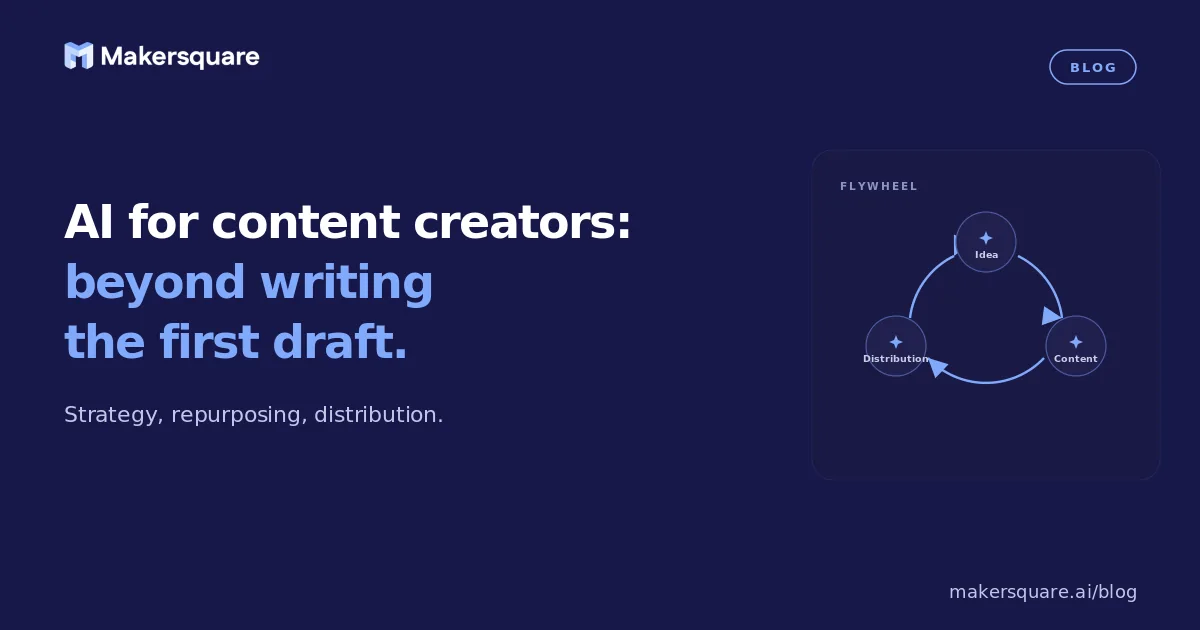
- Most content creators use AI for drafting — but the highest-ROI use cases are research, repurposing, and SEO optimization, which are often more time-consuming than writing itself.
- AI for content creators works best as a force multiplier on existing content: one long-form piece becomes a week of multi-platform content with AI-assisted repurposing.
- The creators under competitive pressure from AI are those producing volume of average content; the ones thriving are those whose value is voice, authority, and perspective.
- A 2025 HubSpot survey found content teams using AI produce 3x more content per person — but the quality gap between AI-assisted human content and pure AI content is still significant.
Most content creators who've experimented with AI started the same way: they asked it to write a blog post draft, were mildly impressed, and moved on. The draft was okay. Not their voice. Useful as a starting point. That's where most creators stop — and it's also where the most interesting AI uses for content haven't begun.
The highest-ROI AI applications for content creators in 2026 are not drafting. They're research acceleration, content repurposing, SEO optimization, and strategy work — all things that used to consume hours and can now be compressed dramatically. Here's how it actually plays out in practice.
Research: compressing the most time-consuming part of content creation
For most content creators, research is the part of content creation that takes the longest and shows up the least in the final product. Finding the right data points, reading the source studies, identifying the counterarguments, synthesizing what other creators have covered — this is genuinely difficult work that AI accelerates without replacing.
The workflow: describe your topic and thesis to Claude, ask what the strongest evidence for and against it is, ask what's been covered extensively by other creators (so you know what to differentiate from), and ask for three specific data points worth including. Then verify the claims and find the primary sources yourself. What used to take two hours of research now takes 30 minutes — the AI sets the map, you verify and fill in the detail.
A 2025 Reuters Institute report on AI in media found that journalists and content producers using AI research assistants reduced pre-writing research time by 45% while maintaining source quality — the key was using AI to identify what to look for, not as a substitute for reading primary sources.1
Repurposing: the highest-leverage content workflow
Here's the use case that changes the economics of content creation most fundamentally: AI-assisted repurposing. Take a 2,000-word blog post, a 45-minute podcast episode, or a 20-minute YouTube video. That single piece of content contains enough material for a LinkedIn post, three Twitter threads, a newsletter section, five short-form video hooks, and a Quora answer. Before AI, extracting all of that was a 3–4 hour additional effort. With AI, it's 30 minutes.
The repurposing workflow: paste the transcript or article into Claude, ask it to extract the three most shareable insights, draft a LinkedIn post from the most interesting one, generate five short-form hooks from the examples in the piece, and outline a newsletter intro. Edit each for your voice and platform context. Done.
HubSpot's 2025 State of Content Marketing report found that content teams using AI for repurposing produced 3x more published content per person without increasing headcount — and saw engagement rates on repurposed content that matched original content creation.2
SEO and content strategy: AI as a research tool, not a content factory
The creators who've gotten AI wrong for SEO are the ones who've used it to pump out keyword-stuffed articles at volume. Google's algorithm updates have been explicitly targeting this pattern, and the results for those creators have not been good.
The creators who've gotten it right are using AI for keyword and topic research, content gap analysis, and title testing — and then writing the actual content themselves or with AI as a co-pilot rather than a ghostwriter. Ask AI what questions are underserved in your content category, what topics your audience searches for that you haven't covered, what a piece on X would need to include to rank for its primary keyword. Use AI's research capacity, apply your creative and experiential judgment.
The SEO opportunity for content creators in 2026 is also in AEO — answer engine optimization for AI search tools. When someone asks Perplexity or Claude about a topic you've written about, your content should be cited. That requires specific structural elements: a direct answer sentence early, a FAQ section, clear H2 structure. AI can help you retrofit existing content for these requirements faster than writing from scratch.
What this means for content creators building AI workflows
The content creators building durable AI-assisted practices are doing something specific: they're using AI to expand what they can produce without diluting their voice, not to replace the original thinking that makes their content worth reading. AI handles research synthesis, repurposing mechanics, and distribution formatting. The creator handles the angle, the examples, the honesty, and the edit that makes everything sound human.
MakerSquare is a 2-week in-person AI builder program in Austin, TX — built for operators, founders, and professionals who want to build real AI tools, not just use them. Content creators and media professionals attend to build specific AI-assisted workflows — research systems, repurposing pipelines, audience tools — not just to explore what's possible. See the curriculum for specifics.
The first draft was always the easy part. AI just made it faster to get there — which means the real competitive advantage now is everything that happens after it.
Join the AI Builder Brief — a weekly newsletter on practical AI tools and workflows for professionals who create, build, and operate.