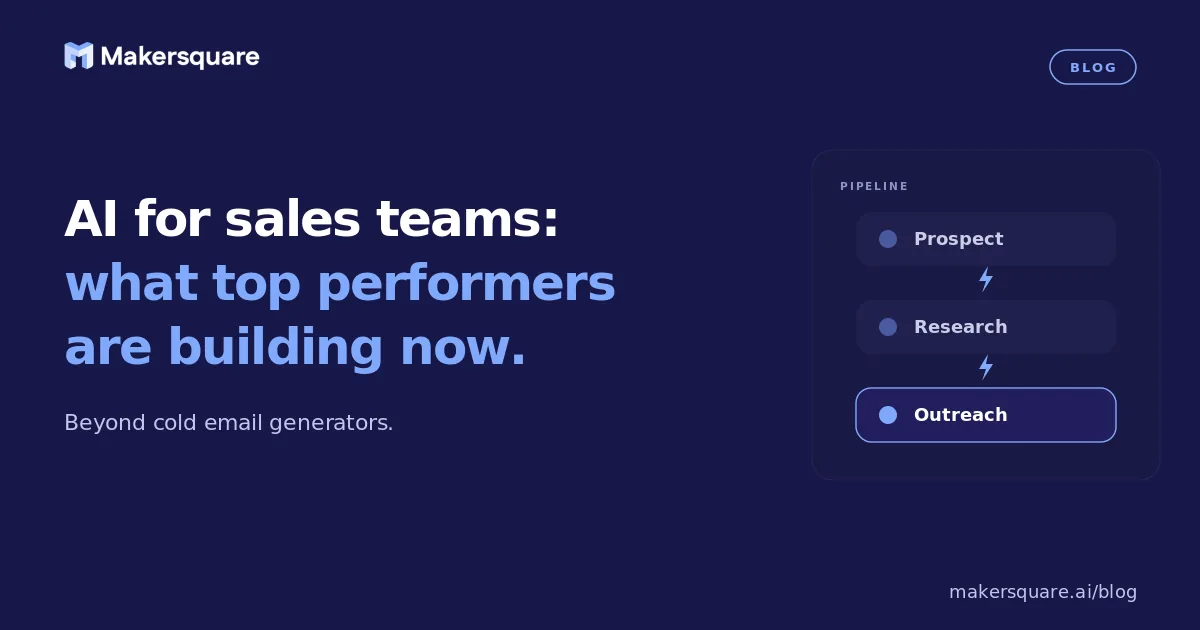
- AI for sales teams delivers the most value on pre-call research, post-call synthesis, and follow-up drafting — not on the conversation itself.
- Top-performing reps aren't just using AI tools; they're building custom workflows that reduce prep time from 45 minutes to under 10.
- Salesforce research found teams using AI report 50% higher productivity — but only when AI is applied to the right tasks.
- The non-obvious insight: AI doesn't make average reps great. It makes great reps impossible to outwork.
Ask a sales manager what their team is doing with AI and you'll usually hear two things: generating cold emails and summarizing call recordings. Both are fine. Neither is what's actually separating top performers right now.
The reps pulling ahead are using AI to compress the unglamorous work — research, admin, follow-up — so they can spend more time on the thing AI can't do: building trust with a specific human being. That's the real AI advantage in sales, and it's more significant than it sounds.
Where AI for sales teams actually moves the number
Pre-call research is the highest-leverage starting point for AI in sales. Before a discovery call, a prepared rep typically spends 30–45 minutes pulling together account context: recent news, the prospect's LinkedIn activity, earnings reports, tech stack, known pain points. Most reps don't do this consistently because it takes too long. AI changes the math.
A custom research brief prompt — fed company name, prospect role, and a few data inputs — can produce a structured, usable pre-call brief in under 3 minutes. Not a generic summary, but a brief that highlights the specific signals most relevant to your product: recent headcount changes, executive transitions, new funding, published challenges from the CEO. This is the kind of preparation that makes discovery calls feel like warm conversations rather than cold interrogations.
According to Salesforce's State of Sales research, reps now spend only 28% of their week actually selling. The rest goes to administrative work: logging activities, writing follow-ups, updating CRM records, building decks. AI can reclaim a meaningful portion of that time — and unlike most "productivity" tools, the time you get back goes directly toward the highest-value activity in your job.
The workflows top performers have already built
The reps using AI most effectively aren't experimenting. They've settled on 3–5 specific workflows that they run consistently. Here's what those look like in practice.
Post-call summary generation. After every discovery or demo call, they feed the transcript (from Gong, Fathom, or Otter) into a prompt that extracts: key pain points mentioned, buying signals, objections, agreed next steps, open questions, and risk flags. What used to take 20 minutes of notes takes 90 seconds. The CRM update writes itself.
Objection response prep. Before a pricing conversation or renewal, they use AI to anticipate the 5 most likely objections — based on deal history, the prospect's role, and competitive context — and draft sharp, honest responses to each. This isn't scripting. It's preparation. The reps who walk in knowing exactly how they'll handle the competitor comparison or the "we need to think about it" are better in the conversation.
Personalized follow-up at scale. After a conference or outbound push with 50+ prospects, a rep can use AI to generate personalized follow-up emails that reference specific conversation details — without writing each one from scratch. Tools like Clay can pull public account data and feed it directly into AI-generated messages, making genuine personalization scalable in a way that wasn't possible two years ago.
What sales AI gets wrong — and what actually works
The version of AI for sales that doesn't work: fully automated outreach, AI-generated cold calls, or any system that removes the human entirely from the relationship-building parts. Buyers are good at detecting automation. Generic, high-volume AI outreach has the same problem as generic, high-volume human outreach — it signals that you didn't do your homework on them specifically.
The version that works: AI handles the scaffolding, the rep handles the relationship. AI researches. AI synthesizes. AI drafts. The rep reviews, adjusts, and shows up to the conversation fully prepared to focus on the person across the table.
A Harvard Business Review analysis of AI adoption in B2B sales found the highest performers used AI most heavily for preparation and follow-through — the tasks before and after the conversation — while protecting the actual sales interaction from automation. That's the right mental model.
What this means for sales teams ready to move
If your sales team is only using AI for email drafts, you're at the surface. The reps and teams pulling ahead have built specific, repeatable workflows for their 3 highest-frequency time sinks — and run them every single day.
MakerSquare is a 2-week in-person AI builder program in Austin, TX — built for operators, founders, and professionals who want to build real AI tools, not just use them. Sales professionals who go through the program leave with custom workflows they can deploy immediately. See what that looks like at makersquare.ai/curriculum.
Sales professionals who leave MakerSquare have built their own pre-call research tools, post-call workflow automations, and outreach systems. Two weeks, in person, with a working tool by the end.