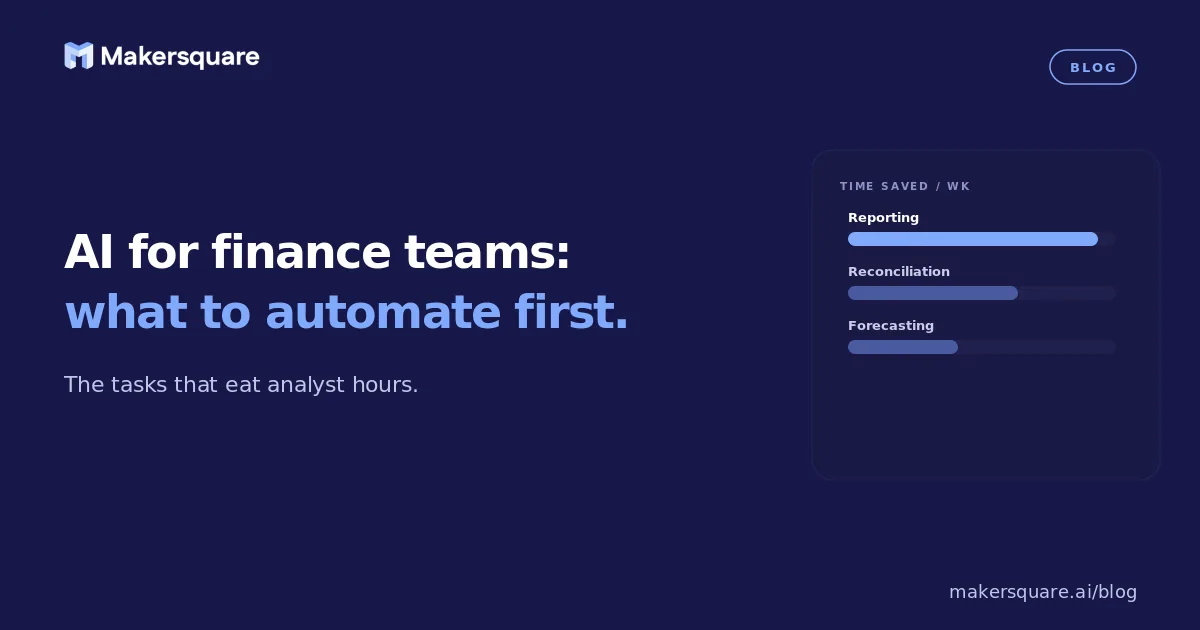
- The highest-ROI AI use cases for finance teams are financial narrative drafting, variance analysis commentary, and contract summarization — all tasks that currently take hours and can be reduced to minutes.
- AI for finance teams is not about replacing financial judgment — it's about eliminating the hours spent turning numbers into words and documents.
- Data privacy is the biggest practical concern: never paste sensitive financial data into consumer AI tools — use tools with enterprise data agreements.
- McKinsey estimates AI could automate 43% of finance activities, but the near-term gains are in reporting and analysis support, not core accounting.
Finance teams are not short on data. They're short on time to do something useful with it. The close process produces numbers — but then someone has to write the board narrative, the investor update, the budget variance commentary, the department-level summary. That's hours of writing every month that doesn't require financial expertise. It requires turning numbers into sentences. AI does that well. The honest answer to "what should finance teams automate first" is: everything that turns data into readable output.
This guide walks through where AI for finance teams actually saves time in 2026, what the risks are, and how to start without overbuilding.
The reporting and narrative problem AI solves immediately
Every finance professional knows this cycle: close ends, numbers are final, and then someone spends three to five hours writing the narrative that explains them. Variance commentary. Board deck bullet points. Department heads' budget summaries. Investor update language. This work is repetitive, formulaic, and time-consuming — and it's the first thing that should go to AI.
A well-prompted AI given the actual numbers can produce a first-draft variance commentary in minutes. "Revenue came in at $2.1M against a $2.3M budget. The shortfall was driven by slower-than-projected enterprise deal close rates in Q2. Cost of goods sold was 2% under budget due to favorable vendor pricing." That sentence structure, repeated across every line item, is something AI handles fluently. You edit for accuracy and tone; AI handles the generation.
McKinsey's 2025 analysis of AI in financial services estimated that AI could automate 43% of finance activities, with the largest near-term gains in reporting, data collection, and analysis support.1 This isn't future-state — it's available today with tools most finance teams already have access to.
Contract review and vendor term summarization
Finance teams routinely review vendor contracts, MSAs, NDAs, and renewal agreements. The question is almost always the same: what are the payment terms, what are the auto-renewal clauses, what are the liability caps, and what are the exit conditions? Reading a 30-page contract to extract those four things takes 45 minutes. Pasting it into Claude and asking those four questions takes three.
This is one of the clearest AI use cases in finance — not because the analysis is sophisticated, but because the task is extremely consistent and the current approach is extremely slow. A mid-sized company reviewing 50 vendor contracts per year is spending 37 hours on contract reading that could be reduced to 3 hours of AI-assisted review and verification.
The important qualifier: AI for contract review should surface the terms, not make the call. The CFO still decides whether the payment terms are acceptable. AI just means they spend their time deciding rather than reading.
Financial modeling assistance and formula generation
AI is surprisingly useful inside Excel and Google Sheets, even for finance professionals who know spreadsheets well. Describing a model structure in plain language — "I need a formula that calculates the 3-year IRR assuming year 1 cash flows from column B and a 10% discount rate" — and getting a working formula back saves meaningful time, especially for less common functions or complex nested logic.
Beyond formula help, AI can assist with model architecture: given a business problem and a set of known variables, what's the right model structure? What assumptions need to be documented? What sensitivity analysis is worth running? These are research and structuring questions, and AI answers them well as a thinking partner — not a decision-maker.
Deloitte's 2025 CFO survey found that 61% of finance leaders are actively exploring AI for financial planning and analysis, with the primary focus on scenario modeling support and reporting automation.2 The gap between "exploring" and "actually deploying" is mostly a skills gap, not a technology gap.
What this means for finance professionals
The finance professionals who are building AI into their daily workflows are not writing code. They're learning to prompt well — to give AI the right context, the right constraints, and the right output format. That's a learnable skill that pays off quickly in a function where the output of every task is a document, a model, or a number with a story.
MakerSquare is a 2-week in-person AI builder program in Austin, TX — built for operators, founders, and professionals who want to build real AI tools, not just use them. Finance professionals who go through the program leave with working AI-assisted reporting workflows, not just an overview of what's possible. See the full curriculum for specifics.
The teams pulling ahead in finance right now aren't the ones with the fanciest AI stack. They're the ones that picked two or three high-volume tasks and built consistent AI workflows around them. Start there.
Join the weekly AI Builder Brief — a short, practical newsletter on building AI workflows for non-technical professionals. Finance, ops, HR, and more.