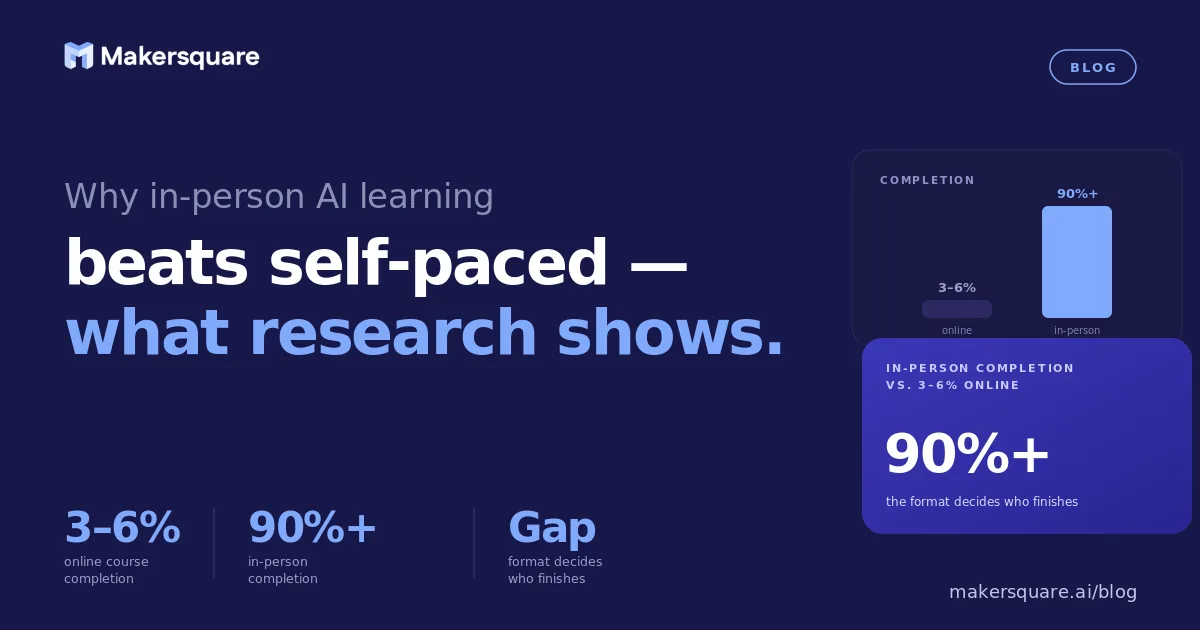
- Completion rates for self-paced online courses run 3–6% at scale. Paid platforms with more friction perform better but rarely exceed 15%.
- Learning science research identifies three mechanisms that drive skill transfer: spaced repetition, immediate feedback, and social accountability. Self-paced online formats are structurally weak on all three.
- BCG's 2026 research found that structured training programs produce 67% higher ROI than unstructured ones — the word 'structured' maps directly to the mechanisms learning science identifies.
- For AI specifically — which requires building judgment through practice, not just acquiring information — the format difference is more significant than for knowledge-based subjects.
The debate about online vs. in-person learning often gets framed as convenience vs. quality. That's not quite the right frame. The real question is structural: what mechanisms does each format use to drive skill transfer, and are those mechanisms strong enough to produce the outcome you're actually trying to reach? For AI specifically — a domain where the skill is building judgment through practice rather than memorizing information — the format matters more than most subjects. Here's what the learning science shows.
The completion rate problem is structural, not motivational
The MIT and Harvard research on massive open online courses — which covered tens of millions of enrollments across dozens of courses — found consistent completion rates of 3 to 6 percent. This is not a result of poor-quality courses. Some of the most carefully produced educational content in the world produces these numbers at scale. The problem is not the content. It is the format.
The specific structural gap: self-paced online courses are designed around information delivery, not skill development. They tell you what you need to know. They do not create the conditions under which you build and retain a new skill. Those conditions — spaced practice, immediate feedback on your work, accountability to others, progressive challenge — require structural mechanisms that most online courses don't have.
The three learning mechanisms that actually drive skill transfer
Spaced repetition and practice over time. The cognitive science of skill acquisition is consistent: skills are built through repeated application across time, with each application slightly more challenging than the last. A single training session, however good, doesn't produce this. Two weeks of daily applied practice does. The compression of an in-person intensive — five days a week, building on the previous day — creates the spaced repetition pattern that produces durable skill.
Immediate feedback on real outputs. The most important learning events are not lectures — they're the moments when you produce something, it doesn't work, and someone explains why. In a self-paced course, the feedback loop is weak: you submit an answer and get a score. In an in-person program, when the tool you're building breaks, an instructor sees what you're doing, identifies the specific error, and helps you fix it in real time. That feedback loop is faster, richer, and more directly connected to the skill you're trying to build.
Social accountability. Learning that happens in front of other people who are working on the same problems produces different effort and retention than learning that happens alone. The cohort effect is documented across educational research: people work harder, engage more deeply, and retain more when they're learning alongside peers with shared goals and visible progress.
Why AI is harder to learn self-paced than most subjects
For a knowledge-based subject — history, theory, a fixed body of information — self-paced online learning is actually quite efficient. You can read, remember, and be tested on information without needing the mechanisms above.
AI is different. Working effectively with AI tools requires developing judgment: knowing when to use AI, how to prompt it clearly, how to evaluate the output, how to iterate when the result isn't right. Judgment is not built by reading about it. It's built by doing — attempting prompts, getting outputs that aren't quite right, figuring out what you should have said differently, and trying again. That iterative cycle requires practice on real tasks, in real time, with feedback.
This is why the BCG research finding is so relevant: 79% of professionals who receive five or more hours of structured AI practice become regular users, compared to 67% without. The threshold isn't time — it's the accumulation of enough real practice cycles to build the judgment that makes AI reliably useful.
When self-paced learning makes sense for AI
In-person programs are not always the right answer. Self-paced online learning makes sense for AI if you're exploring whether the field is relevant to your work before committing time or money, if you need to fill a very specific, narrow knowledge gap (understanding how a particular API works, learning the syntax of a specific tool), or if the cost and time commitment of an in-person program isn't currently feasible.
What self-paced learning reliably produces for AI: familiarity. Knowledge of what the tools are and what they can do. A general sense of how the field works. What it rarely produces: changed workflow, reliable applied skill, the judgment to evaluate AI outputs and iterate on them effectively. If familiarity is the goal, online is efficient. If capability is the goal, the format needs to match.
MakerSquare is built around the learning science described in this post: two weeks of daily applied practice, immediate feedback from instructors, and a cohort of peers working on the same problems. The curriculum reflects that structure — it's available to review.